Halal on Transavia France: the short answer
Transavia France is a low-cost operation that sells snacks, sandwiches and drinks onboard. It does not offer a pre-ordered Muslim meal in the pages reviewed for this guide, and its catering pages do not claim halal certification. For a Muslim passenger this means the decision is made product by product, using the menu, the packaging and, if necessary, a meal brought from home.
That approach is workable on most short flights. A sandwich with a clear ingredient list, a vegetarian item or a packed meal you prepared yourself can all be sensible choices, depending on the standard you follow. The sections below explain which menu applies to your flight, how to read what the airline says about its products, why fresh items run out, and how to keep a record if you have a question afterwards.
- Choose the French menu for flights to and from France.
- Do not read vegetarian or organic labels as halal claims.
- Bring a suitable meal if certainty matters more than convenience.
Which menu applies to your flight
Transavia publishes separate onboard menus for flights to and from France and for flights to and from the Netherlands. If you are flying Transavia France, open the French selection, called Bon Appétit. A sandwich that appears on the Dutch menu does not establish that it will be on your aircraft.
Why this matters for ingredients
Different menus can mean different suppliers, recipes and labels. A product you checked for a previous trip on another route may have been replaced. Look at the menu for your own route before you rely on any item.
The airline’s general menu page also lists hot snacks, sandwiches, soft drinks, juices, sweet and savoury gluten-free snacks and a selection of alcoholic drinks. The range and prices on your flight are those shown in the relevant national menu.
Reading what the product claims
The French catering page highlights vegetarian, organic and gluten-free products. These descriptions tell you something about the recipe, but they do not establish halal certification. A vegetarian sandwich avoids meat, yet it can still contain alcohol-based flavouring or an animal-derived additive, depending on the product.
Meat sandwiches and prepared snacks
For anything containing meat, ask the crew about the exact product, its ingredients and any certification mark printed on the packaging. If no halal mark is shown and the crew cannot say more, treat the product as unconfirmed. Whether an unconfirmed product is acceptable depends on the standard you follow, and that is a question for a qualified scholar, not for a travel guide.
- Read the ingredient list for gelatine, alcohol, lard and animal-derived additives.
- Look for a certification symbol and the name of the certifier.
- If the label is unclear, choose another item.
Why your first choice may be sold out
Transavia France deliberately loads limited quantities of fresh food to reduce waste. On a busy flight, the sandwich you planned to buy may be gone before the trolley reaches your row. Crew may suggest a replacement.
Check any substitute separately. A similar-looking sandwich can use a different meat, dressing or additive, and the fact that the original looked suitable tells you nothing about the replacement. Ask to see the packaging.
Practical ways to reduce the risk
- Decide in advance which two or three items you would accept.
- Eat before boarding on short flights so that a sold-out item is not a problem.
- Keep a sealed snack in your bag as a fallback.
Bringing your own food
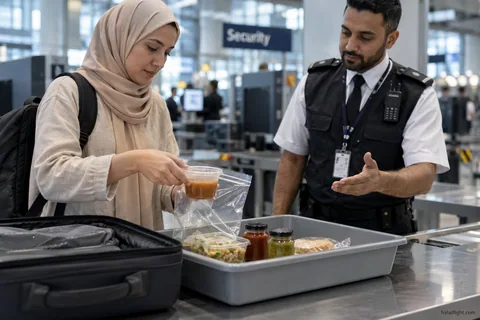
Transavia’s help pages say you may bring your own food and drink. Items not bought at the airport must follow the rules for liquids in hand luggage, and they can also go in checked baggage. The airline also tells passengers to check the import and customs rules of the destination country before travelling.
What suits a packed halal meal
- Solid foods such as sandwiches, wraps, rice dishes in a sealed container, fruit and nuts.
- Dry snacks with an ingredient list you have already checked.
- Soups, sauces and dips only within the security liquid limits; a separate guide covers this in detail.
Fresh meat, dairy and plant products can be restricted at some borders, so eat leftovers before landing or discard them as required. A suitable packed meal reduces dependence on the small selection remaining when the trolley reaches you.
Allergies and ingredient limits
The airline’s help page says it cannot prevent other passengers from eating products containing peanuts or nuts, and that it cannot guarantee that its products are free from allergen traces. Passengers with food allergies are told to carry their own medication, such as an adrenaline auto-injector.
For halal purposes the lesson is similar: the airline publishes allergen and ingredient information in general terms but does not promise that any product is free of a given substance. If a trace amount of an ingredient matters to you for religious reasons, the safest course is food you have prepared or bought from a source you trust.
This page does not give medical advice. Anyone with a medical condition should speak to their own doctor and the airline before flying.
Keep a record of what you bought
If you want to raise a question after the flight, keep evidence. Retain the product packaging or take a photograph of its label showing the ingredient list and any certification mark. Transavia France also provides electronic receipts using flight details and payment information.
The two records do different jobs. The receipt identifies the purchase, the date and the flight. The label is more useful for discussing ingredients, because it shows what the product said at the time. Together they give customer service something concrete to investigate.
- Photograph the label before you open the packet.
- Request the electronic receipt using the flight and payment details.
- Note the date, flight number and the name of the crew member if possible.
Checklist and what to do if it goes wrong
Before you fly, work through this list.
- Open the menu that matches your flight, the French Bon Appétit selection for France.
- Pick two or three acceptable items and note what each contains.
- Pack a suitable meal and check liquid rules and destination import rules.
- At the trolley, ask to read the label of anything you are unsure about.
- Photograph the label and keep your receipt.
If nothing available is suitable
Eat your own food, or accept a drink and a clearly suitable snack. Afterwards, if you believe a product was described wrongly, write to customer service with the flight number, date, photographs and receipt. Differences in how stunning and slaughter are treated are covered in a separate guide on halal meat standards and are not repeated here.
Frequently asked questions
Does Transavia France serve halal sandwiches?
The pages reviewed do not state that Transavia France sells certified halal sandwiches. Its French catering page highlights vegetarian, organic and gluten-free products. For any meat product, ask the crew for the ingredients and check the packaging for a certification mark before buying.
Can I order a Muslim meal in advance on Transavia France?
No pre-ordered Muslim meal is described in the pages reviewed. Food is sold onboard from the menu for your route. If you need certainty, bring your own meal or contact Transavia before your flight to ask whether any arrangement exists for your journey.
Is the Dutch menu the same as the French menu?
No. Transavia publishes separate menus for flights to and from France and the Netherlands. On a Transavia France flight, start with the French Bon Appétit selection. Seeing an item on the Dutch menu does not mean it will be on sale on your flight.
What if the sandwich I want has sold out?
Transavia France loads limited quantities of fresh food to reduce waste, so popular items can run out. If crew suggest a replacement, ask to read its label first. A similar sandwich can contain different meat, dressing or additives, so check it separately.
Can I take my own halal food through security and onto the plane?
Transavia says food may travel in hand or checked baggage, with items not bought at the airport following the hand-luggage liquid rules. You should also check the import and customs rules of your destination before travelling, since some countries restrict meat, dairy and fresh produce.