Start with the airport code
Chengdu has two major airports. Tianfu is TFU; Shuangliu is CTU. Restaurant advice for one cannot be applied to the other, and a review written about Chengdu airport may refer to either. Look at the code on each segment of your booking, including any onward flight, before saving a recommendation.
The official airport site for Tianfu has an English address, but the page that loaded when it was checked for this guide was a recruitment notice, not passenger information. Because of that, no outlet names, opening hours or halal statements are given here. This is a deliberate gap: stating a restaurant that could not be confirmed would be worse than saying nothing.
What this guide offers instead
- A way to identify the right airport and terminal.
- Questions that work in any kitchen in Sichuan.
- A planning method for connections between Chengdu's two airports.
Terminals and what airlines say about them
Tianfu has more than one terminal. Asiana's English airport guide for TFU gives its passengers Terminal 1, with check-in counters D13 to D18 on the fourth floor and a regional office telephone number. It also states that for an international-to-domestic connection the move to Terminal 2 takes about thirty-five minutes, after collecting bags first.
This is guidance for one airline, written for its own flights. Use it only if you fly with that carrier, and check your own airline's page for its terminal, counters and hours. Another airline may use different counters, and a lounge or restaurant arrangement for one passenger group does not apply to others.
Why does this matter for food? Because the outlets you can reach depend on the building you are in and on whether you have already passed security. A meal in the departures area of Terminal 1 does not help if your onward flight leaves from Terminal 2. Write down the terminal for each leg, then search for food in that terminal only.
Asking for a currently operating outlet
If no usable online directory identifies a suitable restaurant, ask at an airport information desk for the name and exact location of a currently operating outlet, ideally written in Chinese characters. A gap in online information does not prove halal food is unavailable. It means the claim still needs checking.
Information staff can tell you where an outlet is and whether it is open. They cannot confirm what it uses in its kitchen. Keep the two questions apart: first locate, then verify.
- Ask which outlets are open now in your terminal and on which floor.
- Ask whether the outlet is before or after security.
- Take the Chinese name of the outlet with you.
- At the counter, ask about the meat, the cooking oil, the stock and any certificate.
The word 清真 (qingzhen) is the usual Chinese term for halal and is worth showing on your phone. It is a useful signal, not a single national standard, so ask what it covers and whether a certificate is displayed. Individual rulings belong to a qualified scholar.
Sichuan noodles: the questions behind the bowl
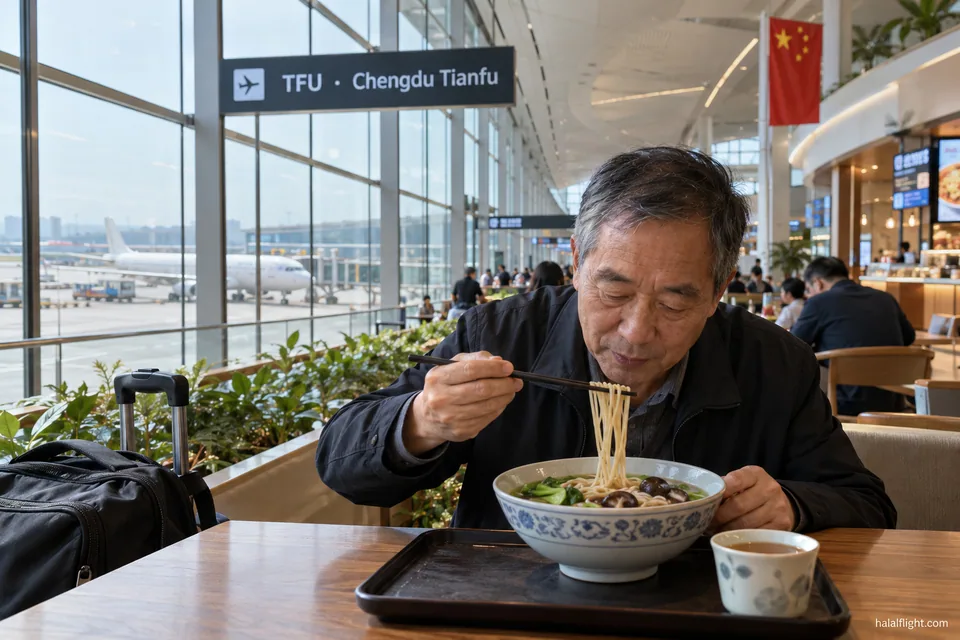
Dishes from Sichuan combine many components, and a request for no spice is not a halal request. A bowl of noodles can contain broth, minced meat, pickles, chilli oil, bean paste and garnishes, each from a different source.
Meat and mince
Ask whether the beef or lamb is 清真 and whether the minced topping is the same meat. Minced toppings are sometimes mixed or pork-based, and they are hard to identify by eye.
Broth and oil
The broth may be simmered with bones from other animals, and oil may be rendered animal fat. Hot-pot style and chilli-oil dishes sometimes use beef tallow, so ask what the oil is.
Sauces and sides
Bean pastes, soy mixtures and dipping sauces may include alcohol or animal products. Cold dishes with preserved vegetables may be dressed with meat-based oils.
Communicating when language is a barrier
Prepare a short written note in Chinese, saving it as a screenshot. Point to each item and wait for a clear answer, not a nod. If the explanation is unclear, pick another outlet or a sealed product with a readable label. A simple dish with ingredients you can see is better than a complex dish you cannot question.
Crossing between Shuangliu and Tianfu
Some journeys involve both Chengdu airports. The operator of Shuangliu publishes news and notices on its site that include an interconnection guide for the two airports, and a notice about moving some passenger flights to and from Hong Kong, Macau and Taiwan between them. The page that was fetched lists these items by title, and the full texts are on linked pages, which were not read for this guide. So no durations, fares or transport methods are stated here.
The practical lesson is clear. If your itinerary arrives at one airport and leaves from the other, you are making an inter-airport trip, not an ordinary connection, and your time for a meal will be much shorter. Check the following before booking or boarding:
- Whether your tickets are on one booking and whether bags are checked through.
- Which airport each leg uses, confirmed on your e-ticket.
- The current transport arrangements, on the operator's pages and with your airline.
- How early you must arrive for check-in at the second airport.
A restaurant detour should never reduce the time needed to check in at the second airport.
Short stops, special meals and prayer
With a short stop, food planning is mostly about not being caught empty-handed. Carry nuts, dried fruit, plain biscuits with a readable label and a water bottle that you can fill after security. Note that import rules for meat and dairy products vary between countries, so check them for your destination before packing anything perishable.
If you have ordered a Muslim meal for your next flight, often coded MOML, a modest snack is enough on the ground. The airline's own page explains how and when to request it, and a separate section of this site covers special meal codes.
For prayer, ask at an information desk about a space, as none could be confirmed from the sources used here. Time your prayer around the boarding call rather than leaving it to the end of the layover.
Packaged versus freshly cooked
Freshly cooked food is more satisfying, but a sealed item removes most of the questions. If you speak little Chinese and the outlet is busy, the sealed option is often the wiser choice.
Checklist and what to do if it goes wrong
Use this short list at TFU.
- Check that your leg uses TFU, not CTU, and note the terminal.
- If connecting between airports, read the operator's and airline's guidance and allow generous time.
- Ask information staff for an open outlet, its Chinese name and its floor.
- Show 清真 on your phone and ask what it covers.
- Ask separately about meat, minced topping, broth, oil, sauces and shared equipment.
- Ask whether a certificate is displayed.
- If unsure, buy a labelled, sealed item instead.
- Keep a back-up snack for the flight.
If the food is not what you were told
Stop eating, say so politely and ask for a refund or a different dish. Note the outlet name, terminal and floor so you can avoid it or report it to the airport. Do not risk missing a flight over a dispute. Afterwards, ask a qualified scholar how to proceed in your circumstances. A calm, specific question at the start is always easier than a complaint at the end.
Frequently asked questions
What is the difference between TFU and CTU in Chengdu?
TFU is Chengdu Tianfu International Airport and CTU is Chengdu Shuangliu International Airport. They are separate airports with their own terminals, transport links and outlets. Check the code on every leg of your booking, and do not apply restaurant advice for one airport to the other.
Is there an official halal restaurant list for Tianfu airport?
None could be confirmed for this guide, as the official English page that loaded was a recruitment notice. Ask an information desk for a currently operating outlet, then ask that outlet about its meat, broth, oil and certificate before ordering.
Is a not spicy Sichuan noodle dish suitable for a halal diet?
Not necessarily. Spice level has nothing to do with halal status. The noodles may include minced meat, broth, chilli oil, pastes and sauces from unknown sources. Ask about each component, and choose a simpler or sealed item if the answers are unclear. A qualified scholar can advise on borderline cases.
Which terminal does Asiana use at Tianfu?
Asiana's English airport guide for TFU lists Terminal 1, with check-in counters D13 to D18 on the fourth floor. That guidance applies to Asiana passengers. Other airlines may use different arrangements, so check your own airline's page and e-ticket.
How much time should I allow between Shuangliu and Tianfu?
No travel time could be confirmed for this guide, so none is given. The Shuangliu operator's site lists an interconnection guide for the two airports. Read it, check your airline's rules for the second airport's check-in deadline, and leave generous time before choosing a restaurant detour.