What to expect at ATL
Hartsfield-Jackson is one of the largest airports in the world by passenger numbers, and its layout shapes every meal decision. The airport's pages reviewed for this guide describe an interactive wayfinding map for searching restaurants, shops and services, and a dining and shopping destination called Skypointe. Neither page, as read, mentions halal or any other dietary category.
That is the central fact for a Muslim traveller: there is no airport-wide statement that tells you which restaurants offer halal meat, and an outlet's name or cuisine is not evidence either way. The workable method is to choose by location first and by ingredients second, then ask staff to describe the dish you intend to order.
- Use the map to locate food near your gate.
- Ask staff about meat source and preparation.
- Keep a sealed option as a fallback.
Start from your departure concourse
At a hub of this size, the gate matters more than the terminal entrance. Decide your concourse, then look at what sits on or near it. The airport's wayfinding map can be searched for terminals, concourses, gates and restaurants, so you can check how far a restaurant is from your gate before you commit.
Before you arrive
If your boarding pass already shows a gate, search for it and look at the nearest outlets. Gates change, so treat this as a draft plan and confirm at the airport on the display boards.
If the gate has not been announced
Pick a central spot you can return from quickly and shortlist two outlets in case the first cannot help. Avoid walking to the far end of a concourse for a meal unless you have a long wait and have already confirmed the gate.
What Skypointe can and cannot tell you
The airport describes Skypointe as a travel-focused shopping, dining and relaxation destination and points visitors to a current list of offerings. As read, the page did not include a restaurant directory or any halal information. It is a starting point for names, not an answer about food.
When a restaurant name suggests Mediterranean, Middle Eastern or Indian cooking, it is tempting to assume halal practice. That would be an assumption. The same applies to chicken dishes and vegetarian labels: a vegetarian dish may still contain alcohol-based flavourings or animal-derived additives, and a chicken dish may come from a supplier that does not follow halal slaughter.
- Treat every outlet as unconfirmed until staff explain the dish.
- Do not extend one answer to the rest of the menu.
- Do not rely on a social media post for current practice; menus and suppliers change.
Questions that get useful answers
Short, specific questions work better than asking whether a restaurant is halal. Staff at a busy counter may not know a general answer, but can often tell you about a single product.
For meat and poultry
- Which supplier provides the chicken or beef, and is it halal slaughtered?
- Can I see a certificate or a supplier statement?
- Is the same grill or fryer used for pork or bacon?
For sauces, stocks and extras
- Does the sauce, dressing or marinade contain alcohol, wine or beer?
- Is the soup or rice cooked in meat stock?
- Do the fries or vegetables share oil with other items?
If staff cannot answer, that is information too. Choose a plainer item or move to the next outlet rather than hoping for the best.
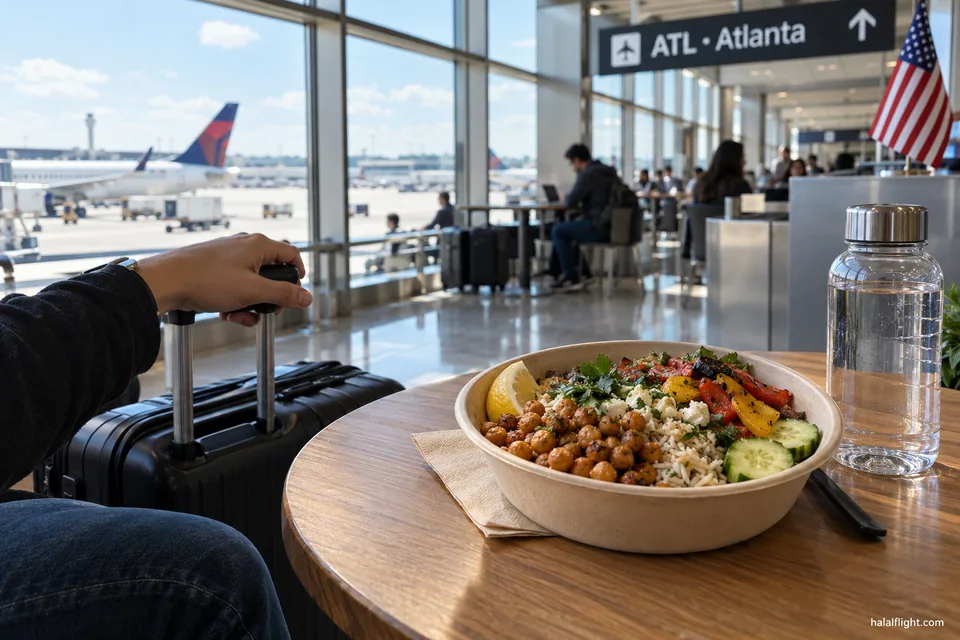
Bowls, wraps and salads: check the whole plate
Grain bowls, salads and wraps look simple but combine many components. Taking off a meat topping does not make the remaining ingredients clear. The base may be cooked in stock, the dressing may contain alcohol or animal products, and toppings may be prepared on a shared surface.
Ask for a short list of what is in the bowl, then build a version with ingredients the staff can describe. A smaller, simpler combination is usually a better choice than a large one you cannot account for.
Practical ordering tips
- Ask for dressing on the side so you can check the label.
- Choose whole fruit, plain rice or plain vegetables as safe building blocks.
- If the preparation area is shared, say so and decide whether it fits your standard.
Personal views on shared preparation areas differ, and a qualified scholar can advise on your own position.
Budgeting time for the Plane Train
The airport's information describes the Plane Train as an underground automated people mover serving seven concourses, running around the clock, with a wait of about 108 seconds if you arrive as the doors close during peak periods, and a scheduled track-maintenance shutdown once a week in the early hours. Separately, the airport's map page says passengers can ride the Plane Train from the international terminal to the domestic terminal and that a free shuttle runs from the international terminal curb to the domestic terminal.
Those figures cover the waiting time only. They do not include walking to the station, queues for the escalator, or the walk from the station to the restaurant. When you add the return, a meal on another concourse can easily take much longer than it looks on the map.
- Count the return trip as well as the outward one.
- Do not leave your concourse if your connection is short.
- Check airport notices for any service change on the day.
Back-up food and what to carry
Because halal information is not published for ATL outlets, a back-up is not optional. Carry food that passes security and has a legible label, such as dates, nuts or dried fruit, and add a sealed sandwich or salad after security if you can read its ingredients.
What to look for on a label
- Gelatine, lard, animal fat or meat extracts.
- Alcohol, wine, beer or rum in sauces and flavourings.
- Cochineal or carmine colour, which some readers avoid.
Keep packaging until you have finished. If you are travelling with children, pack more than you think you need, since delays tend to arrive when options are fewest.
If your flight is international and the airline serves a pre-ordered Muslim meal, the in-flight meal is a different topic from airport food and is covered in the airline and meal-code guides on this site.
Checklist for an ATL meal
- Find your concourse and gate on the wayfinding map.
- Shortlist two outlets near the gate.
- Check whether either needs a Plane Train ride.
- Ask about meat source, alcohol and shared cooking surfaces for the exact dish.
- Order the simplest item you can account for.
- Keep a sealed back-up in your bag.
- Buy before boarding begins; do not gamble on the last ten minutes.
If it goes wrong
If you cannot find a suitable meal, eat the back-up food and keep the receipt for any wasted purchase. If a prepaid in-flight halal meal was not supplied, the separate guide on refunds for prepaid halal meals explains the steps. For a personal ruling on a doubtful meal, ask a qualified scholar.
Frequently asked questions
Does Atlanta airport publish a list of halal restaurants?
The airport pages reviewed for this guide do not mention halal. The wayfinding map and the Skypointe page help you find outlets, but they do not label food as halal. Ask each outlet about the specific dish, the meat supplier and any alcohol in sauces, and keep a sealed back-up in case answers are unclear.
Can I use the Plane Train to find food on another concourse?
Yes, the Plane Train serves seven concourses, but count the waiting time, the walk to and from each station and the return trip before deciding. On a short connection it is usually wiser to eat on your own concourse or choose sealed food.
Is a vegetarian dish at ATL always acceptable?
Not automatically. Vegetarian dishes can contain alcohol-based flavourings, animal-derived additives or be cooked on shared surfaces. Ask what is in the sauce and how the dish is prepared. Views on shared surfaces differ, so ask a qualified scholar if you are unsure about your own position.
How do I find restaurants near my gate at ATL?
Use the interactive wayfinding map on the airport website, which can be searched for terminals, concourses, gates and restaurants. Search for your gate, look at the nearest outlets, then confirm your gate on the display boards at the airport because gates can change.
What should I do if no outlet can explain its ingredients?
Choose sealed food with a full ingredient label, such as fruit, nuts or a packaged sandwich, and read it for gelatine, animal fat and alcohol. Keep the wrapper until you have eaten. Avoid hot food you cannot account for rather than guessing under time pressure.