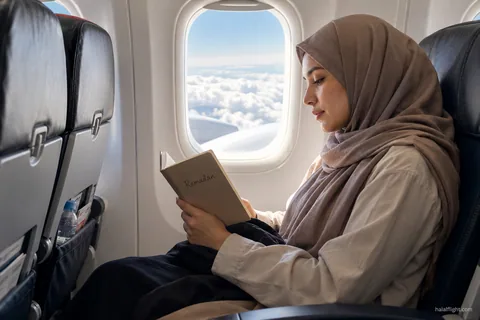
Does premium economy make a meal more halal?
No. Premium economy is a comfort and service tier. The halal question is answered by the airline's catering policy, the caterer at the departure airport and the special-meal code on the booking, not by seat width or the number of courses. On some airlines the same Muslim meal specification is loaded in both cabins; on others, the way it is priced or served differs. The only reliable method is to read the special-meal rules for each cabin you are comparing.
This page looks at the practical differences a Muslim traveller should check between the two cabins. It does not rank airlines. For the top cabins see the guide to business and first class, and for budget carriers see the low-cost guide.
What can differ
- How the Muslim meal is requested and by when.
- Whether it carries a fee in one cabin and not in another.
- Whether the premium menu lets you pre-select a main course, and how that interacts with a special meal.
- Whether snacks, breakfast and second services follow the special-meal rules.
What usually does not differ
The underlying definition of the Muslim meal (commonly described as free of pork, pork derivatives and alcohol) is normally set per airline, not per cabin. Whether the meat is certified halal is a separate question that depends on the departure station, and airlines word this differently.
Two airlines, two different answers
Published policies show how far cabins can diverge, so it helps to look at real examples.
Singapore Airlines: special meals open to every cabin
Singapore Airlines states that special meals, including Muslim meals, are available to all customers, premium economy passengers included, and must be pre-ordered. The airline describes a window of roughly 24 to 56 hours before departure, with some destinations needing longer notice, and tells travellers to check the cut-off for their own departure point. For flights leaving Singapore, it states that Muslim meals are prepared in a halal-certified kitchen. For flights departing elsewhere, it describes meals prepared without pork, lard, pig by-products or alcohol, with halal-certified meat and poultry sourced where operationally feasible.
Corsair: the cabin changes the price
Corsair lists its Muslim meal among special meals that cost 15 euros in economy and premium, while business class receives them free. The same page says that, except on departures from Abidjan and Cotonou, neither the meat nor the preparation methods are halal-certified, and that the meal contains no pork, pork-derived products or alcohol. Requests close 48 hours before departure and are subject to availability. A traveller choosing between cabins on this airline would therefore weigh a fee, not a change in certification.
The two cases show that the cabin matters in the details (fee, deadline, menu choice) while the certification statement tends to follow the departure station. Policies change, so confirm both pages before travelling.
Pre-selected dishes versus a special meal
Premium economy often adds a menu-selection step. Singapore Airlines, for example, lets confirmed premium economy passengers pre-select a main course from the in-flight menu, and on selected routes a Book the Cook option, with selection opening several weeks ahead and closing at least 24 hours before departure. That process is separate from the special-meal request.
The risk is overlap. If you choose a named main from the menu and also hold a Muslim meal request, the airline's system may treat the two as alternatives. Do not assume that choosing a dish replaces or preserves the religious meal.
How to avoid a clash
- Open the manage-booking page and look for separate sections for menu selection and special meals.
- If both appear, ask the airline which one takes priority for your flight.
- Check the saved meal for each passenger after you confirm, not only the confirmation email.
- Keep the screen or email showing the Muslim meal status for boarding.
If the menu offers no choice that clearly meets your needs, the special meal is usually the safer route, provided it is available in your cabin.
Compare every service, not only the main meal
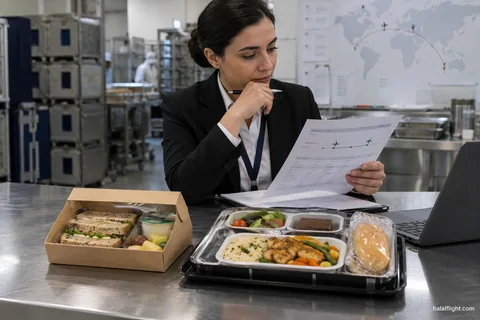
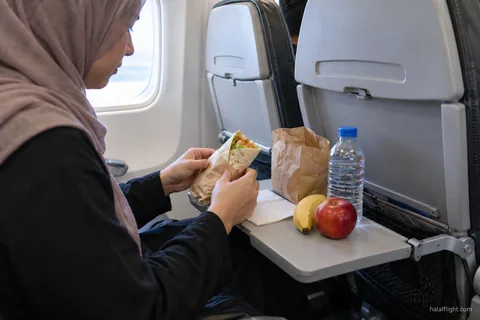
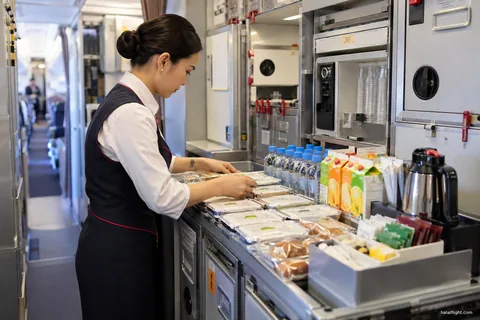
A long-haul premium economy flight may include a hot meal, a snack or sandwich and a pre-arrival breakfast. Economy usually has a similar structure with simpler items. The special meal tray may cover only the main service, with other items drawn from the general stock.
Questions for each service
- Is the second meal or breakfast included in the special-meal order?
- Are bread, butter, cakes and desserts covered by the same ingredient statement?
- If a snack box is served from the galley, does it contain gelatine, lard or alcohol-based flavourings?
- Is there a fruit or cold-meal alternative you can eat safely if the second service is unclear?
Packaged items carry ingredient labels, so read them. For anything unlabelled, ask the crew politely and early in the service. Many travellers carry a small supply of dates, nuts or a sealed snack from home as a back-up, subject to the rules at the destination on bringing in food.
Combined dietary needs need written confirmation
Neither cabin guarantees that two special-meal categories can be combined. A traveller who needs halal and gluten-free, or halal and low-salt, often finds that the airline's meal list offers one code per passenger. The Muslim meal definition does not say that it is free of gluten, dairy, nuts or any other allergen.
Where the second requirement is medical, such as an allergy, speak to the airline before booking and seek advice from a doctor about what level of risk is acceptable on a flight. Airlines generally state that they cannot guarantee an allergen-free environment.
What to ask
- Can the booking carry two meal requirements, or is one code the limit?
- Does the airline offer a meal that satisfies both, and in which cabin?
- If not, what is the recommended alternative, and can it be recorded in the reservation notes?
Plates, glassware and extra courses in premium economy say nothing about ingredients. Rely on the airline's written answer.
Is the upgrade worth it for halal reasons?
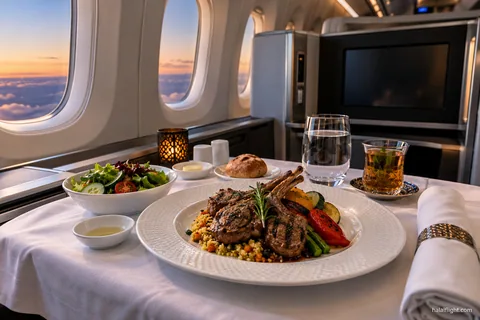
Paying for premium economy only to improve halal assurance is rarely justified, unless the airline's own page shows a difference between the cabins. More often the benefits are comfort: seat pitch, recline, a larger tray and earlier boarding. Those matter on long flights, particularly when fasting or praying, because a wider seat can make movement and prayer easier. They are legitimate reasons to upgrade, but they are separate from catering.
A simple decision test
- Find the special-meal page of the airline and read whether the Muslim meal is offered in both cabins.
- Note any fee difference and any difference in request deadline.
- Check whether the premium menu offers a selection that conflicts with the special meal.
- Decide whether the comfort gain alone justifies the fare difference.
If the answer to the last question is no, an economy seat with a confirmed Muslim meal meets the same religious need at lower cost.
Short flights and codeshares
Cabin rules often change with flight length. Some airlines serve only a snack on short routes, and special meals may not be offered in economy on flights below a certain duration. Check this for each sector of a connecting trip, because a premium economy cabin may exist on the long leg but not on the feeder flight.
Codeshares add another layer. Singapore Airlines, for instance, says that meals can be pre-selected only on codeshare flights that it operates itself. On a flight sold by one airline but operated by another, the operating carrier's catering rules apply, and the sellers' manage-booking page may not carry the request through. Contact the operating airline directly and ask what it will load.
The comparison between short and long journeys is covered separately in the guide to short-haul and long-haul flights.
Checklist before you pay for the upgrade
- Read the airline's special-meal page for your departure station and cabin.
- Note the request deadline and whether it differs by cabin or airport.
- Check whether a fee applies in economy or premium economy.
- Find out if menu pre-selection replaces or sits beside the special meal.
- Ask whether second services and snacks follow the same specification.
- Request the meal for every passenger on the booking, not only the main traveller.
- Check the booking again 24 to 48 hours before departure.
- Take a screenshot of the confirmed meal status.
- Pack a sealed snack and dates as a precaution.
If the meal does not appear on board, ask the crew calmly whether a spare special meal or a suitable general item is available, and report the problem to the airline afterwards with your booking reference. Questions about what is permissible for you personally belong to a qualified scholar.
Frequently asked questions
Is the Muslim meal the same in economy and premium economy?
On many airlines the meal specification is set for the whole airline, so the definition is the same, but the fee, the deadline and the menu around it can differ. Corsair, for example, charges for special meals in economy and premium but not in business. Read the airline's own page for each cabin and confirm before travelling.
Do I have to pay extra for a halal meal in premium economy?
It depends on the airline. Some include special meals in every fare, while Corsair lists a fee of 15 euros for its Muslim meal in economy and premium economy and no charge in business. Check the special-meal page for your airline and route, since fees and conditions can change.
Can I choose a main course and also have a Muslim meal?
Possibly not. On airlines that offer premium economy menu pre-selection, the choice and the special meal may be treated as separate processes. Ask the airline which takes priority, check the booking record for each passenger and keep proof of the Muslim meal status so the crew can see it at boarding.
Are snacks and breakfast covered by my special meal?
Not necessarily. The special-meal tray often covers the main service, while snacks and breakfast may come from general stock. Read ingredient labels on packaged items, ask the crew about anything unlabelled, and carry a sealed snack as a back-up in case the second service is unclear.
Is premium economy worth it only for halal reasons?
Usually not. If the airline offers the same Muslim meal in both cabins, the upgrade improves comfort and service rather than religious assurance. Compare the written policies, then decide whether space, a larger tray and easier movement or prayer justify the fare difference on your route.