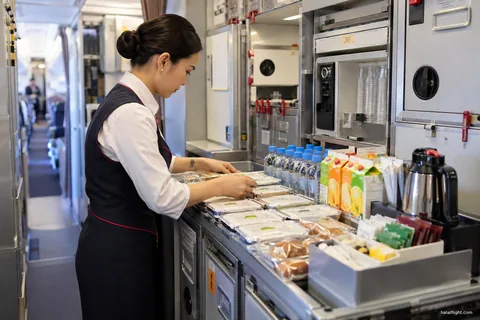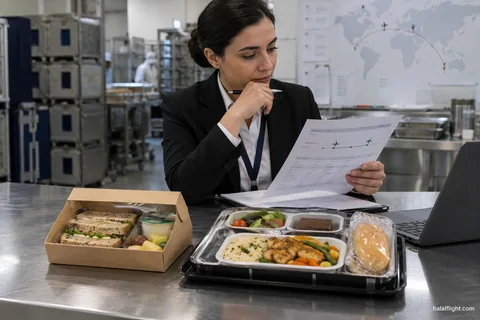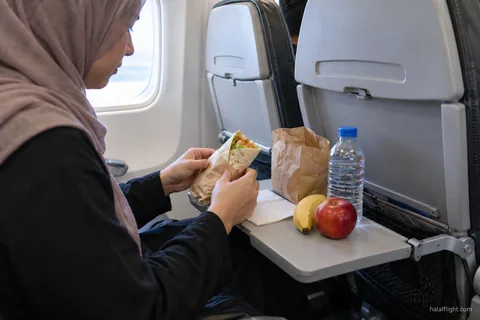
Premium service does not prove halal sourcing
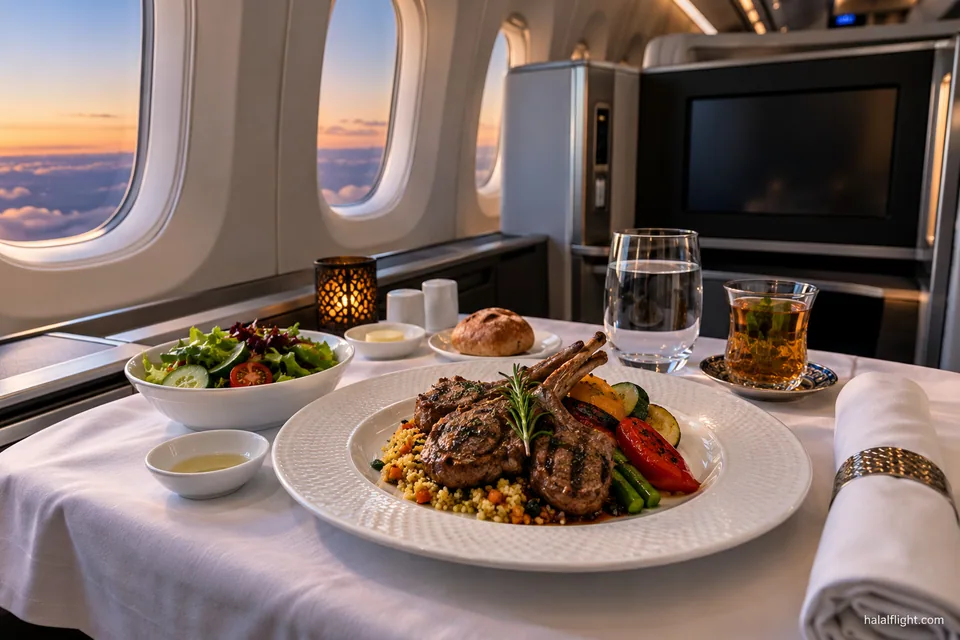
Business and first class bring china, linen, a chef's name on the menu and attentive service. None of that tells you how the meat was slaughtered, whether a sauce contains wine, or whether a dessert is set with gelatin. Presentation and religious compliance are separate questions, and only the airline's own definition of its meal can answer the second.
The practical approach is to start with the airline's published special-meal description. Airlines word this differently. Air France, for example, describes its halal meal as intended for Muslim passengers, with all animal products from animals slaughtered under Islamic rites, and excluding pork and its by-products including gelatin, as well as food and drinks prepared with alcohol. Royal Brunei states that all meals on its flights are halal. Read the equivalent statement for your own carrier before interpreting anything on the tray.
Chef's choices and pre-ordered mains versus a Muslim meal
Many airlines let premium passengers pre-select a main course before the flight. Singapore Airlines, for instance, allows pre-selection through Manage Booking for confirmed bookings in Suites, First, Business and Premium Economy, up to six weeks before departure, with pre-orders needed at least 24 hours before departure. Its special meals are a separate system, available in every cabin and requested through Manage Booking up to four months ahead.
This distinction matters. A dish you pick from the pre-order list is a menu choice. It may be appealing and may even contain no pork, but it is not necessarily the airline's halal meal. If you need the religious category, book it as a special meal, and confirm whether doing so replaces the pre-order option or sits alongside it. Ask the airline rather than assuming.
Questions to ask the airline
- Does the special-meal booking override my main-course selection?
- Is the halal dish prepared on the same menu cycle as the standard one?
- Is the meal available on every sector, including codeshares?
Courses beyond the main dish
A long premium service may include canapes, soup, a cheese course, chocolates or petits fours, often served separately from the main. Because they arrive at different moments, they are easy to overlook, yet each has its own ingredients.
If you are on a confirmed halal special meal, ask the crew early whether every course belongs to that meal. One suitable main does not identify everything offered later. Likely trouble spots include:
- Canapes with cured meats, or sauces finished with wine.
- Soups made on meat stock of unknown source.
- Cheese, where the rennet source is rarely listed.
- Desserts and chocolates with gelatin, alcohol-based liqueur or flavouring.
- Bread or crackers served with a butter or spread you have not been told about.
Where an answer is unclear, declining the item costs little. Opinions on borderline ingredients differ, and an individual ruling should come from a qualified scholar.
Drinks service and alcohol in the cabin
Premium cabins usually have a generous drinks list that includes wine, spirits and cocktails. Alcohol is also used in some sauces and desserts. Most travellers handle this by asking crew to use a clean glass and by choosing from the non-alcoholic list, which often includes specialty teas, mocktails and fresh juices.
If you are sensitive to the cabin environment, you can ask politely for the crew to avoid pouring alcohol near you, though this is a request and not a right. Airlines that do not serve alcohol at all are covered on a separate page of this site.
Codeshare and multi-airline journeys
Premium tickets are often sold by one airline and flown by another. Singapore Airlines notes that meals can be pre-selected only on codeshare flights that it operates. Air France notes that special meals are available on certain flights within Europe and on all intercontinental flights, subject to availability, and that in Business on medium-haul flights over 2h30, only the vegan meal is offered.
Examples like these show why a request made once may not follow you across a trip. For every flight number on your ticket, identify the operating airline, find its special-meal page, and make the request there if needed. Do the same for the return leg, as deadlines can differ by direction and route.
Flexible dining and timing limits
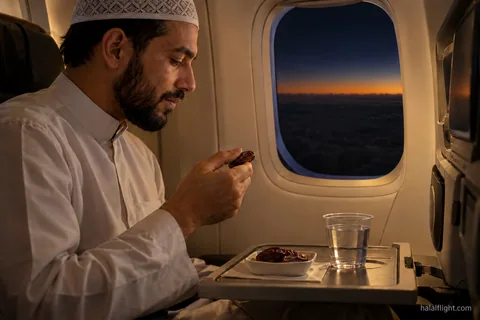
On-demand dining lets you eat when you wish, but it is still limited by the flight. Turbulence, seat-belt signs and preparation for landing can delay or cut short a service. If you are fasting, taking medication with food, or breaking a fast at sunset, discuss timing with the crew early rather than assuming a hot meal can be delivered at an exact minute.
Tell the crew at the start of the flight which meal you have booked, and ask when the first service will be. For fasting travellers, the page on breaking a fast during flights covers timing in detail.
The lounge is a separate question
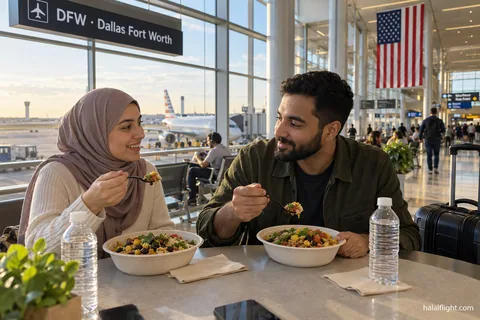
Premium tickets often include lounge access, and a lounge may be run by an airport operator or a third party rather than the airline. The airline's onboard halal statement does not necessarily extend to a buffet or kitchen run by someone else.
Look at what is labelled, ask staff whether meat dishes are halal, and read any signage about ingredients. If the answer is unclear, choose vegetarian, fish or fruit dishes, or eat your own food. Assess the lounge as its own venue, not as an extension of the flight.
Checklist and what to do if the meal is wrong
- Read your airline's definition of its Muslim or halal meal.
- Book it as a special meal, not just a menu choice.
- Note each deadline for each flight and operating airline.
- Check the booking record a few days before travel.
- Tell the crew at boarding what you have booked.
- Ask about every course, including snacks, cheese and sweets.
- Check the lounge separately.
If it goes wrong
If your meal is missing or looks doubtful, say so quietly and early, and ask what the alternatives are. Eat something you are sure about, such as fruit, plain bread or items you brought. Afterwards, write to the airline with your booking reference and flight details so the failure is recorded. Keep your own dried fruit and nuts in the cabin bag as insurance.
Frequently asked questions
Is all food in business class halal on Muslim airlines?
Not necessarily on every carrier, so read each airline's own statement. Royal Brunei says all its meals are halal. Other airlines, including those based in Muslim-majority countries, may still treat halal as a special-meal category. Check the policy for the airline and route you are flying.
Should I book a Muslim meal or choose a main course in advance?
They are separate systems on some airlines. A pre-ordered main is a menu choice, while a special meal is a defined category. If you need the religious meal, book it as a special meal and ask whether it replaces or sits beside your pre-order.
Do the starters and desserts count as halal in first class?
Do not assume so. Ask whether every course belongs to the confirmed halal meal, because canapes, soups, cheese, chocolates and desserts may contain gelatin, alcohol-based flavouring or unlisted ingredients. If the answer is unclear, skip the item and rely on food you know is suitable.
Is the airport lounge food covered by the airline's halal meal?
Usually not. A lounge may be run by another operator, and the airline's onboard statement does not necessarily cover its buffet or kitchen. Ask staff about meat dishes, read any labels, and choose vegetarian, fish or fruit if you cannot confirm the source.
How late can I request a halal meal for a premium flight?
It depends on the airline. Air France asks for special meals no later than 24 hours before the flight, and Singapore Airlines allows special meal changes between 24 and 56 hours before departure depending on the meal. Always request as early as possible and check the operating airline's rules.