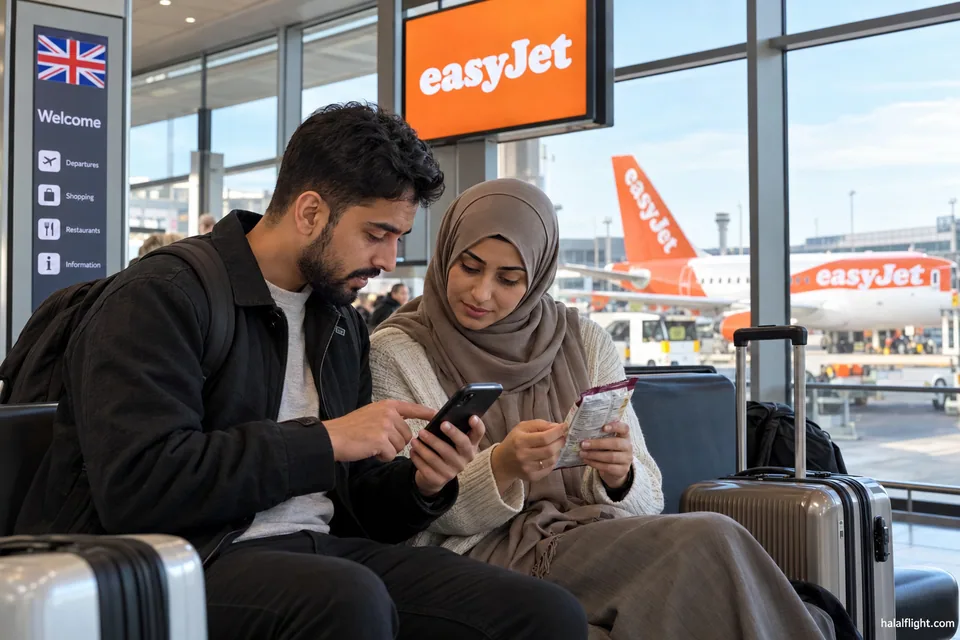
The position for halal travellers on easyJet
easyJet is a low-cost airline that sells food and drink onboard and does not run a conventional special-meal service. Its café page describes Costa coffees, fresh sandwiches, hot meals, snacks and meal deals, with categories such as breakfast, light bites and drinks. The page does not mention halal options, and there is no sign of a separately prepared Muslim meal.
For a Muslim passenger the practical question is therefore different from the one on a full-service airline. Instead of asking which meal code to book, you decide between three routes:
- Buy a product from the café menu after checking what is in it.
- Bring your own halal food on board.
- Eat before the flight and carry only a light snack.
The sections below take each in turn, and explain how to avoid the common mistake of treating a vegetarian label as a halal label.
Reading the café menu and brochure
The menu is published as a brochure, linked from the café page, with separate editions for different operating companies: easyJet UK, easyJet Europe, easyJet Switzerland and a Morocco edition covering Marrakech departures. A digital version is also available in the easyJet app. Pick the edition that matches the flight you are taking, because the range can differ.
What to look for
- Products with no meat at all, which remove the main halal question.
- Meat products, where you need to ask about the source and preparation.
- Ingredients such as gelatine, alcohol-based flavourings, lard or animal rennet in snacks and baked goods.
The café page itself does not list allergen or dietary details, so the brochure and the crew are your sources. Because stock and recipes change, read the product description again on the day, and do not rely on memory from a previous flight.
Vegetarian is not the same as halal
A vegetarian or vegan symbol answers a question about animal products. It does not certify a food as halal. A vegetarian item can still contain alcohol as a flavouring or carrier, or it can include additives of uncertain origin, depending on the recipe. At the same time, many people find that a plainly vegetarian item, such as a cheese sandwich or a packet of crisps with a short ingredient list, is the easiest low-risk choice when no halal product is identified.
Your own standard decides which of these you accept. Different schools and scholars hold different positions on questions such as trace alcohol and animal-derived additives, and an individual ruling belongs to a qualified scholar. The point for planning is to know where your own line is before you reach the front of the café queue.
Asking the crew the right questions
Cabin crew can read the product information they have on board, but they are not food specialists and cannot certify anything as halal. Short, concrete questions get the best answers:
- Can you read me the ingredient list for this item?
- Does it contain meat, gelatine or alcohol?
- Is there a printed allergen or dietary sheet I can look at?
If the crew cannot answer, choose a different item or eat your own food. Do not ask them to confirm that something is halal if you are not willing to accept an uncertain reply. If you want a firmer answer before flying, contact easyJet through its online help and live chat, which the café page points to, and ask for any written information about halal status.
Bringing your own food
easyJet's guidance states that you can bring food into the cabin, even though the airline sells food and drink on board. This is often the most practical solution for a passenger who wants certainty.
Good choices for hand luggage
- Sandwiches or wraps you have prepared at home.
- Dates, nuts, dried fruit and seeds.
- Sealed bakery items, rice cakes, crackers and bars with a clear ingredient list.
- Fruit that is allowed on your route.
Pack food so that it can be removed and shown at security if requested. Eat messy or strongly scented items with consideration for neighbours in the tight cabin.
Destination rules
Import rules differ between countries. Some restrict meat, dairy and fresh produce, and an unopened sandwich left in your bag can cause trouble at a border. Finish or discard such food before arrival and check your destination's rules.
Liquid foods and the 100ml limit
easyJet's guidance on restricted items warns that there is a 100ml limit for liquid food, giving soup and custard as examples. That limit applies at security, so it matters most at your departure airport. Baby food, milk and sterilised water are treated as exceptions up to a total, but ordinary liquid and paste foods are not.
- Soups, stews, yoghurts, hummus, sauces and spreads can all count as liquid or semi-liquid foods.
- Put any such item in a container of no more than 100ml, within the transparent bag rule, or buy it after security.
- Check the rules of your airport, as the exact screening procedure varies.
Permission to bring food does not override these limits, so choose solid foods whenever possible.
Meal deals, fasting and short flights
If a meal deal or fare bundle influences your choice, check exactly which items can be selected and whether any contain meat. A bundle that looks convenient is no use if the only hot item is one you cannot eat.
Most easyJet flights are short, so a good rule is to eat a proper meal in the terminal beforehand, using restaurants where you are comfortable with the ingredients, and to treat the café as a back-up. During Ramadan, work out sunset time at your departure and arrival points. Short-haul routes often make it possible to break the fast on the ground; if the sunset falls in the air, carry dates and water. Prayer on flights is covered on a separate page.
Checklist and if you cannot find anything suitable
- Open the brochure for your edition of easyJet and note vegetarian or fish items.
- Decide in advance what level of assurance you need.
- Pack a solid halal-suitable meal and snacks in your cabin bag.
- Keep any liquid food within the 100ml rule or buy it after security.
- Ask the crew for ingredient details before you pay for a café product.
- Check destination import rules for food.
- Finish or discard fresh items before landing where required.
If nothing suits you
Do not buy something you are unsure about only because you are hungry. Drink water, eat from your own supplies and plan a proper meal on arrival. Afterwards, you can write to easyJet through its online help to request clearer dietary information on its menu.
Frequently asked questions
Does easyJet serve halal food?
easyJet's café page lists sandwiches, hot food, snacks and drinks but does not mention halal options, and the airline does not appear to run a separate Muslim meal. If halal status matters, choose a plainly vegetarian product, ask the crew about ingredients, or bring your own food.
Can I bring my own food on an easyJet flight?
Yes. easyJet's guidance says you can bring food into the cabin, even though it sells food on board. Your food must still pass security, so respect the 100ml limit on liquid foods, and check import rules for your destination before you travel.
Is a vegetarian sandwich from easyJet halal?
Not automatically. A vegetarian label means no meat, but it does not certify halal status, and ingredients such as alcohol-based flavourings or animal-derived additives may still appear. Ask the crew to read the ingredients, and follow your own standard or a scholar's advice.
Can I take soup or yoghurt through security for an easyJet flight?
Only within the limits. easyJet's guidance states that there is a 100ml limit for liquid food such as soup or custard, and yoghurt, sauces and spreads can be treated in the same way. Carry solid foods, or buy liquid items after security.
Where can I find easyJet's food menu and ingredients?
The café page links to a brochure, with editions for the UK, Europe, Switzerland and Morocco, and a digital version in the easyJet app. The page does not list dietary details, so ask the crew or use the airline's live chat for ingredient questions.