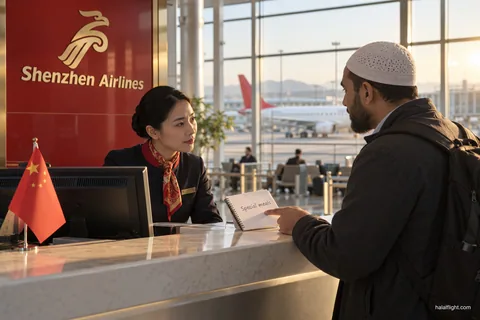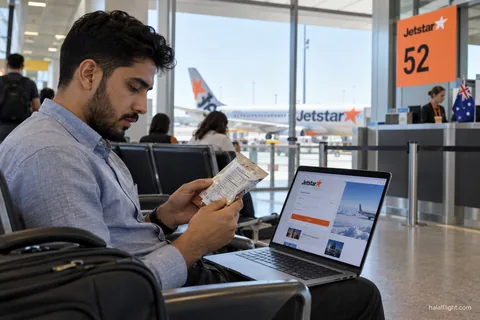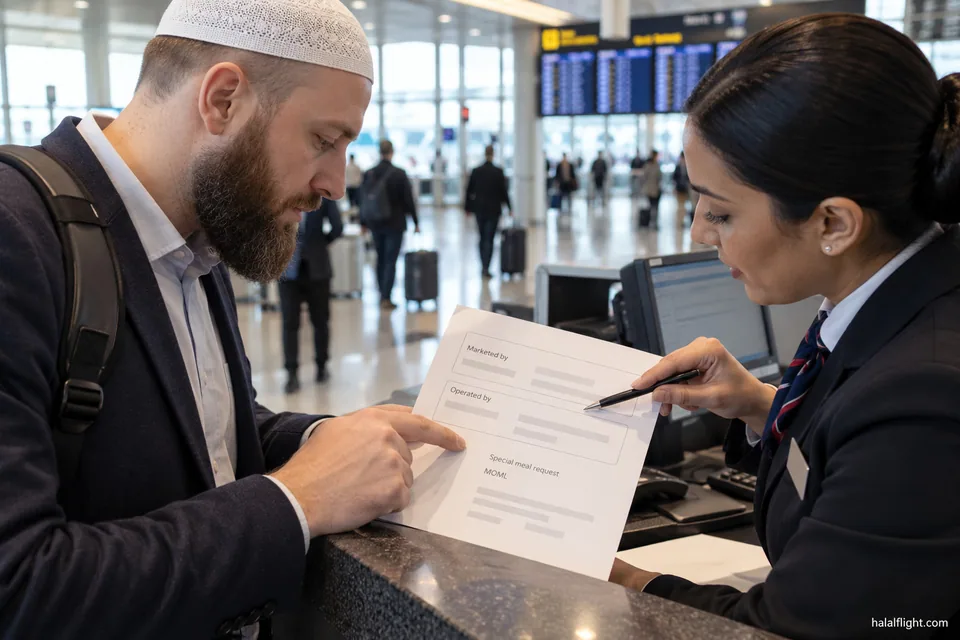
Start with who actually operates the flight
A codeshare ticket carries one airline's flight number while another airline flies the aircraft. The airline whose code is on your ticket is the marketing carrier, and the one operating the flight is the operating carrier. Catering, the meal list and the cut-off for special meals normally belong to the operating carrier, because it loads the food.
Find the words operated by on your booking, e-ticket or the airline's schedule page, before you read any halal policy. A statement that the seller serves only halal food may not describe what is loaded on a partner's aircraft. The same applies in reverse: a seller with a limited meal list can sell you a seat on a partner whose catering is stronger.
This page is about the request process on partner-operated flights. Changing a meal after a schedule change and managing several airlines in one journey have separate guides, which are referred to below only in passing.
What airlines say about partner-operated flights
Airlines are consistent on the principle, though not on the process. The statements below come from their own pages and should be checked again before you travel.
- Finnair says its special meal request in Manage booking applies only to Finnair-operated flights. For flights operated by other airlines, it advises going to the operating airline's website or contacting them directly.
- ANA says requests through its website apply only to ANA-operated flights, and that for codeshare flights operated by other airlines its customers should contact ANA directly. It also says that allergen-free policies may differ on codeshare flights.
- Korean Air asks for special meals at least 24 hours before departure, and states a longer period of 48 hours for codeshare flights.
- Qatar Airways says it cannot guarantee special meals on partner or codeshare flights, and asks passengers to confirm those with the operating airline.
- TAP Air Portugal says special meals are only available on flights operated by TAP or on its behalf, and does not address other codeshare flights, so confirm with TAP.
- Singapore Airlines limits codeshare meal preselection on its website to flights it operates.
Taken together, these statements show that a request entered through the seller's website often covers only the seller's own flights. A partner segment that is missing from the meal screen should be treated as not yet requested.
Getting the partner reservation reference
The operating airline holds its own copy of your booking, and it can use a different locator from the one on your ticket. If its website cannot find your journey with the ticket reference, you may need the partner's record locator.
Where to find it
- Check the confirmation email and the booking details for a field called airline reference, partner reference or operated-by reference.
- Look in the seller's app or Manage booking page under the flight details.
- If it is not shown, ask the seller's contact centre to give you the operating carrier's locator.
With the locator and your surname, most airlines let you retrieve the booking on their own site and view the special meal section. If they cannot, contact them by phone or through a travel agent, and ask which channel they use for requests on flights sold by partners.
Request routes and who to contact first
Because processes differ, use this order.
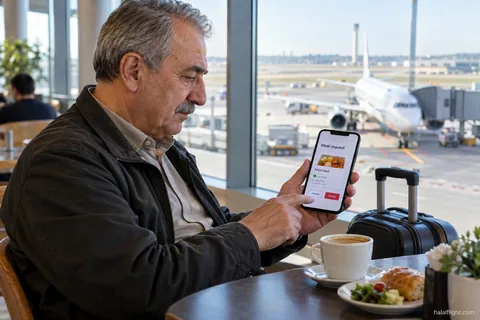
- Try the seller's Manage booking page and look for a meal option on the partner segment.
- If the option is absent or marked unavailable, go to the operating airline's site and retrieve the booking with the partner locator.
- If that fails, phone the operating airline and quote your ticket number and booking references, and ask which of them it can use to find the booking.
- If you bought through a travel agency, ask the agency to place the request. ANA says customers who bought through a travel agency should make the request through the agency.
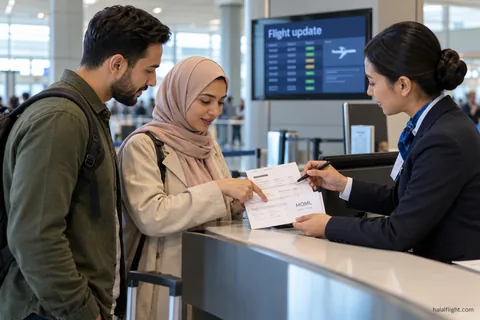
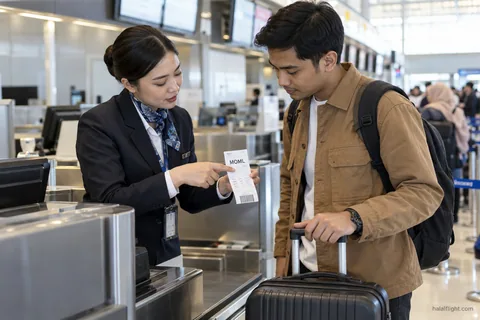
Ask for the meal by name, for example Muslim meal, and mention the code MOML where the agent uses codes. If you have a second need, such as a lactose-free meal, ask whether both can be recorded, since many systems allow one special meal per passenger and segment.
Reconcile what each airline tells you
When two companies handle one journey, an acknowledgement from one does not prove the other holds the request. The seller may say it has sent the request, while the operating airline's record shows nothing.
- Ask the operating airline to read back what is on its booking for your name and flight.
- Ask the seller when and how the message was sent, and whether you will receive a confirmation.
- Keep both replies, particularly where one uses a general description such as halal meal and the other displays a code such as MOML.
If you hold two different answers, trust the operating airline's record for what will be loaded, and ask the seller to correct its own booking so the two match. Allow for the earlier deadline: Korean Air's 48 hours for codeshare flights shows that a partner-operated sector can need more notice than a flight the airline operates itself.
Outbound and return flights can differ
One ticket brand can cover an outbound flight on its own aircraft and a return flight on a partner's. Responsibility for the meal changes with the operator, so the request, the deadline and the contact all need to be checked for each direction.
A schedule change can also move a sector to another airline. If that happens, the request you made may no longer apply, and it needs repeating with the new operating carrier. The guide to reconfirming a Muslim meal after a flight change covers that situation in detail. Korean Air also notes that if you request a special meal, all meals for the itinerary will be special meals, so check how your own request is applied across sectors.
What to expect of the halal standard
The operating airline's catering rules decide what a Muslim meal contains. ANA, for instance, describes its Muslim meal as excluding pork products, gelatin, alcohol and alcohol-based flavouring extracts, and its allergen-free policies may differ on codeshare flights. Other airlines state that all meals are halal. Read the operating airline's description and do not assume the seller's wording applies.
If a statement is unclear, ask the operating airline how its halal assurance works on your route. Questions about whether a particular practice meets your own standard are for a qualified scholar.
Checklist and what to do if the meal is missing
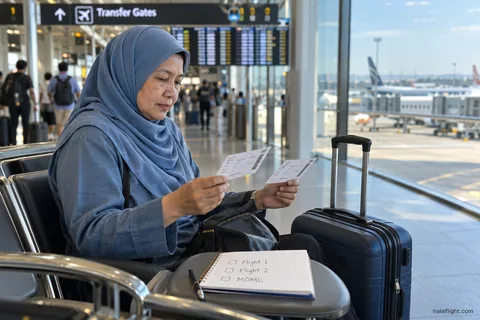
- Find operated by for each flight on your itinerary.
- Get the operating airline's booking reference.
- Read that airline's special meal page, including any codeshare note and deadline.
- Request the meal on the operating airline's channel, and tell the seller too.
- Check both records show the same meal.
- Reconfirm after any schedule change, and carry a labelled reserve of food.
If the meal is not on board
Ask the crew what can be offered and decline anything you cannot confirm. Afterwards, write to the operating airline and copy the seller, giving the booking references, flight number and the confirmations you hold.
Frequently asked questions
Who do I ask for a halal meal on a codeshare flight?
Ask the operating airline, the one that flies the aircraft, whose name appears next to operated by on your booking. The seller's website may not support requests on partner flights. Finnair and Qatar Airways both direct passengers to the operating airline for meals on partner flights.
Why does the meal option not appear for my partner flight?
Many airlines restrict their online meal tools to the flights they operate. Finnair and Singapore Airlines both state this limit. Missing options are usually a system limit, not proof that no meal is available. Contact the operating airline or the seller's contact centre.
Do I need a different booking reference?
Often yes. The operating airline can use its own record locator, different from the ticket seller's. If its site cannot find your trip, ask the seller for the partner reference, and keep your surname and ticket number ready when you phone the operating airline.
Do codeshare flights need earlier meal requests?
Sometimes. Korean Air asks for special meals at least 24 hours before departure and 48 hours on codeshare flights. Other airlines do not state a separate period. Check the operating airline's deadline and request as early as you can.
What if the seller says the request was sent but the operator has nothing?
Ask the operating airline to read back what is on its record, then ask the seller to resend the request in writing and give you a reference. Keep both replies. Carry a reserve of food in case the meal is not loaded.