A realistic plan for halal food at PVG
Shanghai Pudong is a large airport with more than one terminal and separate satellite buildings. The airport publishes a dining directory, a passenger guide and ground-transport information on its English pages. None of these should be read as a statement that a particular outlet is halal. They tell you where food is and how the airport works, and the assurance has to come from the outlet.
The best plan has four steps. Find out which building your flight uses. Locate food that is reachable without leaving your permitted area. Ask direct questions about broth, meat and sauces. Keep a labelled reserve in case the answers are not clear. The sections below take these in turn.
The airport's websites were not readable by the tools used to prepare this guide, so no outlet names, opening hours or prices are given here. Take them from the official pages on the day you travel, because they are the only reliable current source.
Record the full location, including the satellite
Pudong dining listings can name the terminal, a floor, whether the area is domestic or international, and in some cases a satellite building and a specific gate. A restaurant that carries the PVG name may not sit along the route your ticket allows.
What to write down
- Terminal number and, if relevant, satellite building.
- Floor, and whether the outlet is in the domestic or international zone.
- The gate range nearest to it.
- The opening hours shown in the directory.
Keep all of this together, not just the outlet name. If you connect between buildings, ask airport staff how the transfer works for your ticket before you commit to a restaurant, because moving between buildings takes time and may involve a transport link.
Noodle bowls, broth and meat sourcing
A noodle bowl topped with vegetables may be made with meat stock, lard or flavoured sauces. A photograph of the finished dish cannot show how the broth was made, so the question has to be asked.
Questions that get a useful answer
- Is the broth made from meat, bone or vegetables only?
- Is the meat halal, and who supplies or certifies it?
- Is any lard or pork fat used in cooking the noodles or the vegetables?
- Do the sauces or chilli oils contain alcohol or meat extracts?
Keep questions short and ask about the specific dish. If a staff member cannot say what is in the broth, that is itself an answer. Choose something with ingredients that can be named, or use your reserve.
Do not infer suitability from a regional cuisine. A cuisine name tells you about style, not about sourcing or certification.
Using the Chinese word 清真
The term 清真 (qīngzhēn) is widely used in China for halal food. Showing it on your phone, along with a short note, can help staff understand that you need food prepared to a religious standard, not just food without a visible ingredient.
A useful note might say that you need 清真 food, that you do not eat pork or food cooked with alcohol, and that you want to know whether the dish uses meat stock. Write it in Chinese and English, and keep a screenshot in case the signal is weak.
A sign or word on a shopfront is a claim, not a proof. Ask what the sign covers: the entire menu, one dish or one counter. Ask whether the preparation meets the standard you follow. If you want a formal assurance, ask whether a certificate is displayed and read what it says.
Whether an outlet's standard satisfies your own requirements is a matter for you and, where you need guidance, a qualified scholar.
Finish the transfer steps before you look for food
If you are connecting at Pudong, read the airport's passenger guide for the transfer procedure relevant to your ticket before planning a meal. Requirements differ with the type of ticket, the airlines involved and whether you change terminals, and the guide is the official place to check them.
Complete any required formalities and find your onward departure area first. Then calculate how much time actually remains, including the walk or transport between buildings and the time to clear any checks. Only then choose a restaurant.
This order prevents a common mistake: eating in a part of the airport you cannot return from, or finding that the outlet you picked lies on the wrong side of a checkpoint. If your next flight is with a different airline, check its boarding time and gate closing time as well, and keep a margin.
Leaving the airport for a meal
The airport publishes ground-transport options, but leaving to eat in the city depends on whether you are permitted to enter China on your ticket and visa status, and on a realistic return time through security. Entry rules vary by nationality and itinerary, so check them with the airline or the relevant authority well before you travel.
For most connections, a city meal is not worth the risk. A restaurant that is known to you can still be delayed by traffic, queues or a closed kitchen. If spare time is short, a labelled reserve is more dependable than an unconfirmed restaurant outside the airport.
If you do have a long layover and permission to leave, plan the return as carefully as the outbound trip: note the last safe time to head back, and allow for check-in and security on your return.
Packaged food and a reserve
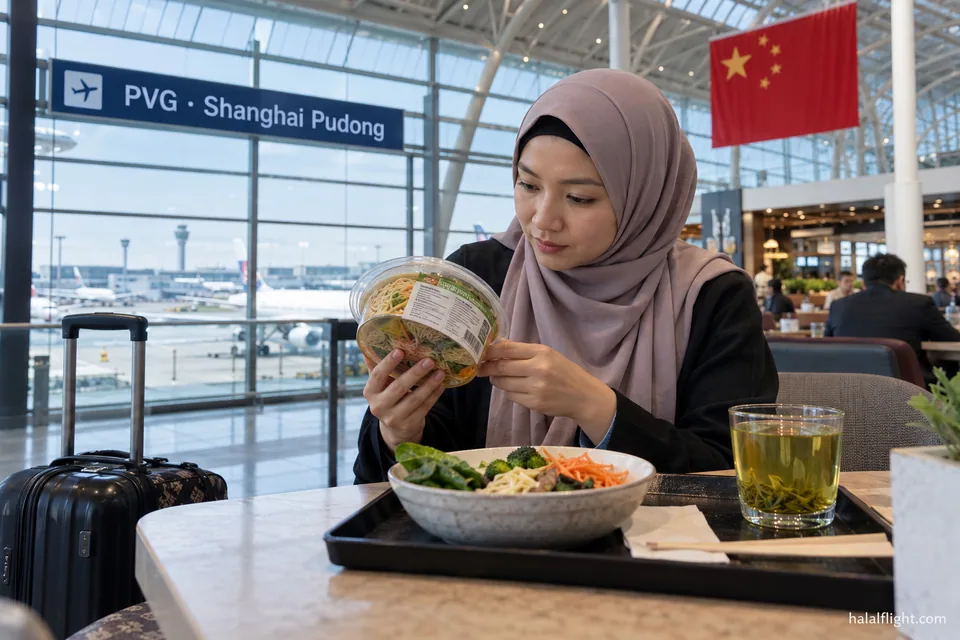
Packaged food can bridge a gap when restaurant answers are unclear, but inspect each product separately. A Chinese ingredient panel may list gelatine, animal fat, lard, alcohol or flavourings that need explaining. Take a clear photograph of the full panel, including the product name and manufacturer, rather than a cropped symbol.
A translation of ingredients is not evidence of halal certification. Look for a certification mark and, if you want to rely on it, check who issued it. Sealed nuts, dried fruit, plain biscuits and similar items are easier to judge than ready-made meals.
If you bring food from home, read the entry rules for China and for any transit country, as limits on meat, dairy and fresh produce can be strict.
Checklist and what to do if it goes wrong
- Confirm your terminal, satellite building and gate range.
- Read the airport's passenger guide for your transfer type.
- Open the dining directory and note floor, zone and hours for two or three outlets.
- Show your 清真 note and ask about broth, meat source and sauces.
- Keep a reserve and recheck boarding time after eating.
If it goes wrong
If the outlet you chose is closed, ask at a service desk which food outlets near your gate are open. If answers about ingredients are unclear, choose a simple item you can identify or eat from your reserve. If you discover afterwards that a dish contained something you avoid, put the question to a qualified scholar; opinions differ and circumstances matter.
If a delay leaves you hungry for hours, tell the airline staff. They may be able to direct you to services available to delayed passengers.
Frequently asked questions
Is there halal food at Shanghai Pudong Airport?
The airport publishes a dining directory, but a listing does not itself confirm halal status. You will need to ask each outlet about its meat source, broth and sauces, or look for a displayed certificate. If you cannot get a clear answer, rely on sealed, labelled food from a reserve.
How do I say halal in Chinese at Pudong?
The usual word is 清真 (qīngzhēn). Show it on your phone with a short note saying you avoid pork and alcohol and want to know about meat stock. A sign using the word is a claim, so still ask which dishes it covers and how they are prepared.
Can noodle soup contain meat even if it looks vegetarian?
Yes. The broth may be made with meat or bone stock, and sauces or oils may contain animal fat or other ingredients. A photograph or visible toppings cannot show this. Ask specifically about the broth and the source of any meat before ordering.
Should I leave Pudong Airport for a halal meal in the city?
Usually not on a connection. Leaving depends on whether you are permitted to enter on your ticket and visa status, and you need time to return through security. If time is short, a labelled reserve is more dependable than an unconfirmed restaurant outside the airport.
Do I need to check my transfer procedure before eating?
Yes. The airport passenger guide explains connection procedures, and requirements differ with your ticket. Complete formalities and identify your onward departure area first, then count the time needed to move between buildings, and only after that decide where and whether to eat.
How can I check an airport packaged food label?
Photograph the whole ingredient panel with the product name and manufacturer. Look for gelatine, animal fat, lard or alcohol, and for any certification mark with its issuer named. A translation of the ingredients is not proof of halal certification, so judge each product on its own.