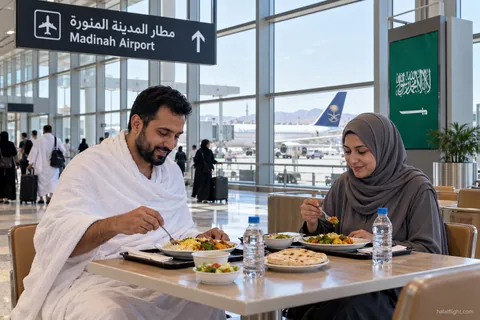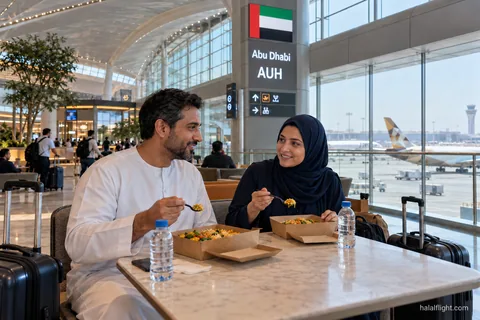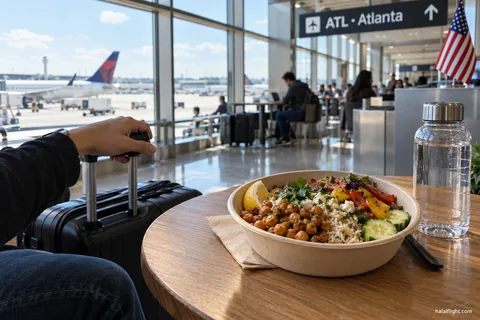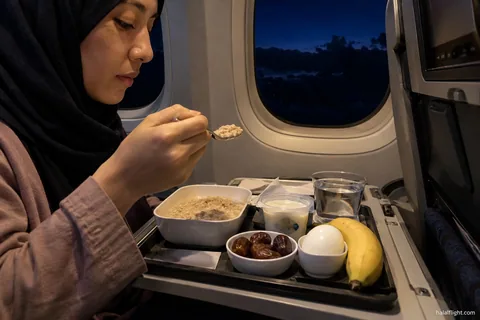
Lounge catering is its own operation
Many travellers assume that a lounge carrying an airline's name serves the same food as the airline's cabin. That is not a safe assumption. Lounges can be run by the airline, by the airport, by a third-party operator or by a card programme, and each may use different caterers and suppliers. The aircraft meal you pre-order and the buffet in the lounge are separate questions.
So the useful first question is not "is this lounge halal?" but "who runs this lounge, and what do they say about its food?" The operator's own lounge page, or the person at the reception desk, is the right source. A rumour from another traveller, or the fact that the airline serves halal meals on board, does not establish anything about the lounge kitchen.
Whole-kitchen statements versus individual labelled dishes
There are two quite different situations, and it helps to know which one you are in.
A halal kitchen
The operator states that all meat and prepared dishes are halal. This is the stronger position, because you do not need to inspect each tray. Ask whether the statement covers drinks, desserts and sauces too, and whether a certificate or supplier letter exists.
A mixed buffet with some halal dishes
Here, specific dishes carry a label while the rest do not. Only the labelled items fall under the assurance. Neighbouring unlabelled meat dishes, sauces and soups should be treated as unknown until staff tell you otherwise. The labelling system, and who is accountable for it, is worth asking about.
Reading the labels and asking about the rest
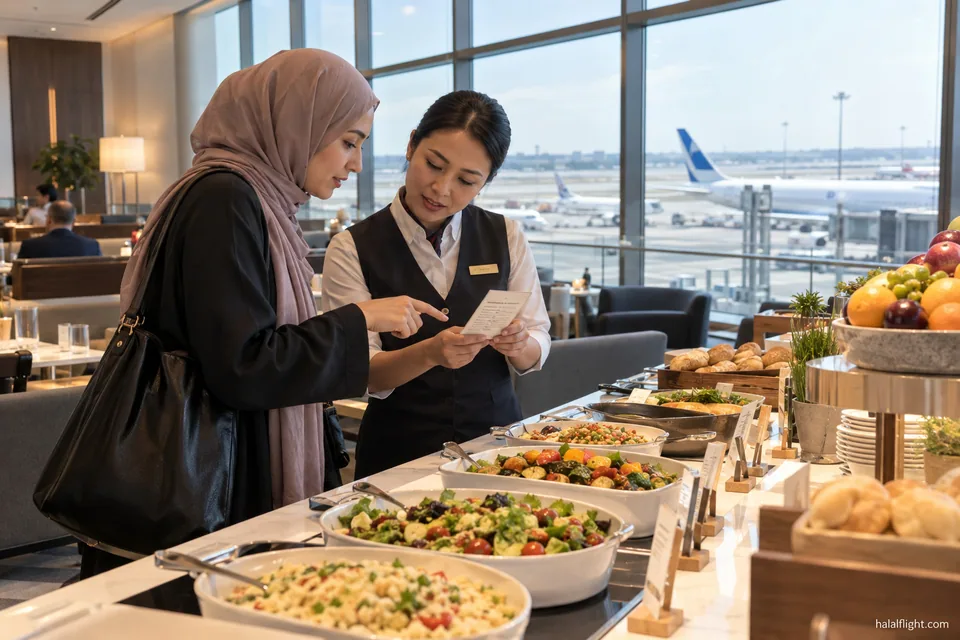
Before you pick up a plate, read the little cards. Look at the dish name, any halal wording, allergen notes and the certifying body if one is shown. Then ask about anything that is not covered.
- Unlabelled meat, such as a stew or kebab: what is the source?
- Sauces, dressings and soups: do they contain alcohol, gelatine or animal-derived stock?
- Pastries and desserts: are they made with gelatine, lard or alcohol-based flavourings?
- Drinks and the bar: is any alcohol used in cooked dishes or desserts?
Be wary of reading too much into the setting. Regional cuisine, Arabic-style decoration or a lounge's location in a Muslim-majority country does not tell you who supplied each dish or how it was prepared. Evidence comes from labels and staff, not atmosphere.
Serving spoons, tongs and shared surfaces
Buffets create cross-contact in a way that a plated meal does not. A single pair of tongs moved from one dish to another can carry meat juices, fat or alcohol-based sauce to a dish that looked acceptable.
- Check that every dish has its own utensil.
- Do not move utensils between trays, and tell staff if someone else has.
- If handling looks uncertain, ask for a fresh portion from the kitchen rather than improvising at the station.
- Consider choosing sealed or individually wrapped items when the area is busy.
How strict to be about trace cross-contact is a question on which scholars differ, so follow the guidance of the scholar you normally consult. The practical point is that you can reduce the risk quickly by asking for a clean serving.
Ramadan programmes: what is promised and where
Some carriers publish Ramadan arrangements, but these have a defined scope. Emirates has said that its seven lounges at Dubai serve Arabic sweets, dates and coffee during Ramadan, that First and Business Class lounges add traditional hot and cold dishes and desserts, and that lounges in Cairo and Jeddah offer Ramadan dishes. It also states that each Emirates lounge has prayer rooms and washing facilities, and that selected gates hand out iftar boxes containing water, laban, a banana and dates.
Notice what this does not say: it does not promise an iftar buffet at every lounge an Emirates passenger might use, or at partner airlines' lounges. Programmes are seasonal and location-specific. Check the current programme for the lounge and date you will use, and confirm whether your ticket class or status gives you entry.
Access, fees and timing
Entry rules are part of the meal plan. Some lounges admit passengers by ticket class or loyalty status, some sell entry at the door, and some require a pre-booking. The Pearl Lounge at Abu Dhabi, for instance, is presented by the airport operator with food facilities, prayer facilities and entry conditions, including paid access; its page should be read directly for current terms.
Work through the logistics before you rely on a lounge for a meal.
- Where is the lounge, and is it before or after the final security point?
- What are the opening hours, and do they cover your departure time?
- Is there a maximum stay?
- How far is it from your gate?
Leave enough time to eat, pray and reach the gate without rushing. Gates are sometimes announced late, and a long walk can cut a planned meal short.
Using independent halal guidance as a reference
If you want to understand what "halal" generally requires of prepared food, certifying bodies publish consumer guidance. The Islamic Religious Council of Singapore (MUIS), for example, sets out basic principles, groups items as halal, non-halal or doubtful, and explains the criteria for processed foods, such as no non-halal ingredients and no cross-contamination in preparation, storage and transport. It also provides a way to look up certified establishments in Singapore.
Such material is useful for vocabulary and for forming good questions. It does not certify any lounge outside the body's own scheme, so it cannot replace the lounge operator's statement. Where a lounge cites a certifier, check that body's own page or ask to see the certificate.
Checklist if the lounge cannot answer
- Find out who operates the lounge and read their page before you go.
- Ask on arrival: whole kitchen or labelled dishes only?
- Read every label, then ask about unlabelled meat, sauces and desserts.
- Check that each dish has its own utensil, or ask for a fresh portion.
- Prefer simple items you can verify, such as fruit, plain rice, vegetables, bread and packaged products with ingredient lists.
- Keep a sealed snack in your bag in case nothing is clearly suitable.
- If you have a pre-booked in-flight meal, confirm it with the airline, because the lounge says nothing about it.
For layover-long planning, see the guide on long airport layovers; for Ramadan flights, the suhoor guide covers meals on board.
Frequently asked questions
Are airline lounges always halal if the airline serves halal meals?
No. A lounge can have a different operator and caterer from the aircraft. Halal status on board does not carry over. Ask the lounge staff or read the operator's page to find out whether the whole kitchen is halal or only certain labelled dishes.
What should I ask at a lounge buffet to check halal food?
Ask whether the kitchen is entirely halal or only some dishes, who supplies the meat, whether sauces and desserts contain alcohol or gelatine, and whether each tray has a separate utensil. Request a certificate or supplier letter if a halal claim is made.
Do all Emirates lounges serve iftar during Ramadan?
Not necessarily. Emirates has described Ramadan refreshments in its Dubai lounges and Ramadan dishes in Cairo and Jeddah, with extra dishes in First and Business Class lounges. Offers are seasonal and location-specific, so confirm the current programme for your lounge and date before travelling.
Can I pay to enter a lounge for the food?
Some lounges sell entry, as the Pearl Lounge at Abu Dhabi's airport describes in its conditions, while others admit only certain ticket classes or members. Check the operator's page for prices, hours and stay limits, and weigh the cost against the chance that halal status is unclear.
Is a lounge in a Muslim-majority country automatically halal?
Location alone does not prove it. The lounge may use many suppliers, and a mixed menu may include items such as alcohol-based sauces or non-halal products for international guests. Look for labels, a stated policy or documentation, and ask staff about anything unlabelled.