Four questions that decide a layover meal
A layover of several hours looks like plenty of time to eat well, yet the meal often goes wrong for practical reasons rather than religious ones. Before you think about menus, answer four questions.
- Where can I go? Which part of the airport is open to a passenger on your ticket.
- What is open when I am there? Kitchen hours, not airport hours.
- Can I confirm halal status? At the outlet, for the dish.
- What if I cannot? A backup that keeps safely for hours.
This page covers those questions for any airport. For a particular airport, the guides for individual airports on this site go into local detail, and this page does not repeat them. The method here is the same whether you are in a hub with dozens of restaurants or a small airport with one cafe.
Work out which area you can actually enter
An airport can list many restaurants and still leave you with very few. Some sit in the public hall before security, some only after it, and some in a different terminal or concourse from your arrival and departure gates. Immigration adds another line: if you have to clear border control to leave the transit area, your options change, and so do the rules about getting back.
Match both gates to the directory
Note the gate or area where you arrive and the one where your next flight departs. Then look at the airport's official dining directory and keep only the venues that sit on your side of any checkpoint. Dubai, for example, publishes a restaurant directory that can be filtered by terminal and by access before or after security, which is the kind of tool to look for at any large hub. The number of restaurants in the airport matters far less than the number you can reach.
Leaving the transit area
If you consider leaving, check entry requirements for your passport, the visa position and how long re-screening may take. A long layover offers possibilities, but none of them is worth risking the onward flight.
Kitchen hours are not airport hours
Many airports operate through the night, and a terminal can be busy at 3am while its restaurants are closed. A late arrival, a delay or an overnight connection can therefore leave you in an open building with nothing hot to eat.
- Check the serving hours of the specific outlet, not only the airport's general opening.
- Remember that hours may change by day of the week or by season.
- If no suitable outlet is open late, buy your meal earlier in the connection, or before your previous flight.
- Carry a dry reserve in case plans change.
When a delay pushes your arrival later than planned, reassess at once. Do not wait until you are hungry and the counters are shut.
Hot food that is available only from a single kiosk can also run out. Treat any late-night plan as provisional until you have the food in your hand.
Separate the location from the halal assurance
An airport directory tells you that a restaurant exists and where it is. It does not certify the food. Whether the meat is halal, whether a dish contains alcohol, and how the kitchen avoids contact with pork are questions for the outlet.
A short script for the counter
- "Is the meat in this dish halal at this branch? Who certifies it?"
- "Does the sauce or stock contain alcohol or animal fat?"
- "Is it cooked on a surface shared with pork?"
Look for a visible certificate and check the name and date if one is shown. If the answer is unclear, treat it as a no and move on. Allow time for a second choice: with a long layover you can afford to ask, but you should still not leave the decision to the last half hour.
Views on borderline cases differ between scholars and schools of law. For a personal ruling on, say, a shared kitchen or a country's labelling system, consult a qualified scholar before you travel.
Storing a packed meal across a long stop
A meal that is fine for a three-hour flight can be a problem across a ten-hour layover, because it spends much more time out of the fridge. United States food-safety guidance describes a temperature range between about 4.4C and 60C in which bacteria multiply fastest, and advises that perishable food should not stay at room temperature for more than two hours, or one hour in hot conditions above 32C.
What that means in practice
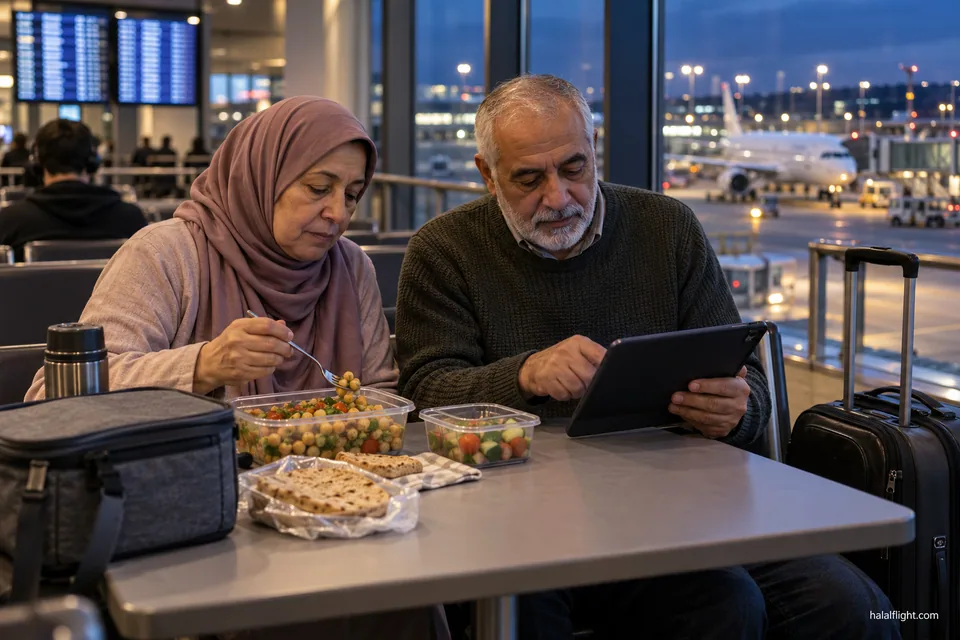
- Prefer shelf-stable food if you cannot keep things cold: whole fruit, nuts, hard cheese, crackers, canned fish or meat and condiments.
- If you pack perishables, use an insulated bag with two cold sources, such as a frozen gel pack above and below the food.
- Chill cooked food before packing it.
- Throw away food that has been out too long; do not rely on smell.
Do not assume that a lounge, a cafe or a hotel will store your personal food. Facilities vary, and staff are not obliged to hold it. Ask first, and expect the answer to be no.
Carrying food between countries
A journey in several segments adds another rule layer. Airlines generally allow passengers to bring their own food, and some suggest choosing food that does not need chilling or heating on board. Singapore Airlines, for instance, advises following local security rules on food and liquids, and warns that some countries do not allow certain foods in transit, so quarantine laws should be checked for multi-segment journeys.
That applies to anyone, whatever the airline. Meat and dairy are the usual restrictions at borders, and sealed packaging does not exempt them. Liquids, gels and sauces are limited at security checkpoints, and each connecting airport applies its own screening.
- Check the import rules of the country where you land and any country where you clear immigration.
- Eat perishable food before you reach a border.
- Keep items in original packaging with the label visible.
Protect the time for the next flight
The longer the layover, the easier it is to relax too much. Build the plan backwards from boarding. Include the walk to the gate, any train or shuttle between terminals, security re-screening and the airline's boarding deadline, which can be earlier than the departure time on your ticket.
If you have two separate tickets, the rules are different from a single through-ticket: you may have to collect bags, check in again and clear border control. Confirm this with the airline when you book.
Set an alarm for the time you must start walking, not for departure, and check the gate screens after each meal. Gates change, and a relaxed seat in a restaurant is a poor place to find that your flight has been moved to another end of the building.
If you want to pray, find a space early, so that prayer and meals do not compete for the last hour.
Checklist and what to do if it goes wrong
- Note your arrival and departure gates and any border checkpoint between them.
- Use the official dining directory to shortlist outlets you can reach.
- Check kitchen hours for the actual hours of your stop.
- Ask the halal questions at the counter and look for a certificate.
- Pack a shelf-stable reserve and keep perishables cold or eat them early.
- Check destination food rules before carrying anything across a border.
- Set an alarm for your walk to the next gate.
If it goes wrong
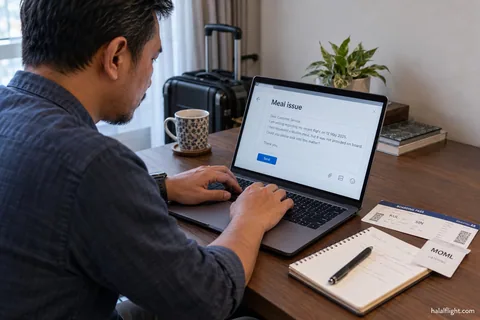
If everything suitable is closed, use your reserve and drink water; a simple meal is acceptable until you can eat properly. If a delay turns a long layover into an overnight stay, ask the airline what meal and accommodation help it provides, and ask in writing if possible. If a meal on board was missed, the complaint process is covered in a separate page on this site.
Frequently asked questions
How do I find halal food during a long layover?
Match your arrival and departure gates to the airport's official dining directory, keep only outlets you can reach, then check each one's serving hours and ask about halal meat and ingredients at the counter. Carry a shelf-stable backup in case nothing suitable is open or the answer is unclear.
Are airport restaurants open all night?
Not necessarily. An airport may run around the clock while individual kitchens close early. Check the serving hours for the specific outlet and for the day you travel. If you will arrive late, buy food earlier in the journey or carry a dry reserve.
How long can a packed meal stay out safely during a layover?
United States food-safety guidance says perishable food should not sit at room temperature for more than two hours, or one hour in heat above 32C. For a long layover, choose shelf-stable foods or use an insulated bag with two cold sources, and discard anything kept too long.
Can I take my own food from one country to the next?
Airlines usually allow it, but countries restrict meat, dairy and some produce at the border, and liquids are limited at every security check. Check the rules of your destination and any country where you clear immigration, and eat perishable items before arrival.
Should I leave the airport during a long layover to eat?
Only if you are sure you can. Check whether your passport needs a visa, how long immigration and re-screening may take, and whether your bags are checked through. A good meal is never worth risking the next flight, so leave a generous margin or stay inside.