The short answer for PKX
Beijing Daxing International Airport, code PKX, opened as Beijing's second major airport and is run separately from Capital. For this guide, the airport's own portal returned only page metadata when it was fetched, so no outlet list or halal statement could be confirmed. Nothing here should be read as a promise that a particular restaurant is halal.
What a traveller can do is build a reliable routine. Work out where in the building you will be, find a named outlet through the airport's channels, and then ask that outlet about each ingredient group. Where answers are weak, fall back on packaged food with a legible ingredient list.
Why this approach is safer
A halal claim belongs to a specific kitchen on a specific day. Directories, apps and blog posts tell you where something is; only the outlet can tell you what is in it. Keeping those two questions apart prevents most disappointments.
Keeping Daxing separate from Capital
Capital uses PEK and Daxing uses PKX. Many search results simply say Beijing airport, and a restaurant review may refer to either. Confirm the code on every segment of your ticket before using any recommendation.
It also helps to know that the two airports are far apart in practice, so a mistake cannot be corrected by taking a short walk. If you land at one and depart from the other, you are in a cross-city journey, not an ordinary connection, and the time you have for food will shrink sharply. Check the airline's guidance for that case. A separate page covers Capital in more detail, so this guide stays with Daxing.
- Check the three-letter code in your booking.
- Use the airport's own portal for Daxing information.
- Ignore Capital-only terminal numbers and outlet names.
Finding an outlet and its exact location
When an online description gives a restaurant name but no floor or zone, go to an information desk and ask for three things: the Chinese name of the outlet, the floor, and whether it is before or after security. Writing the name in Chinese characters on your phone saves repeated explanation. Information staff can usually tell you where a business is. They are not responsible for its ingredients, and an airport employee locating a restaurant is not confirming its halal status.
Then ask the restaurant itself, politely and specifically.
- Is the meat 清真 or from a Muslim supplier, and can you see a certificate?
- Is the stock made from the same meat, or from other bones?
- Do any dishes contain lard, pork or alcohol, including in sauces?
- Are the pans, steamers and utensils shared with pork?
If the answers are inconsistent between two staff members, choose another place. The outlet that answers calmly and in detail is generally the better choice, though it still does not replace the personal judgment of a scholar you trust.
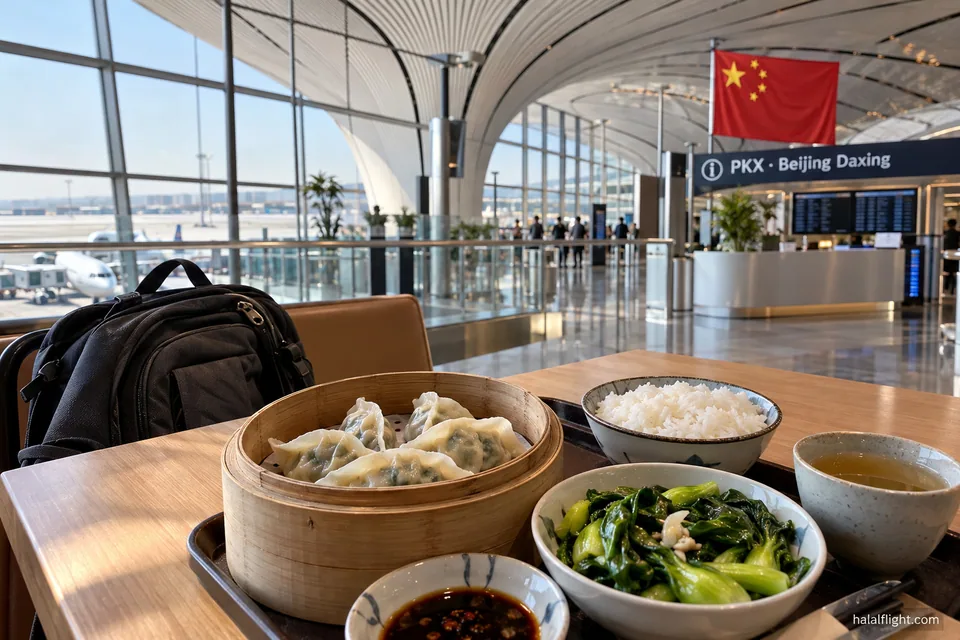
What is inside a steamed dumpling
A dumpling's steamed appearance says nothing about its filling or about what went into the dough, the stock inside it or the dipping sauce beside it. Treat each part as a separate question.
Filling
Minced meat may be pork, beef, lamb or a mixture, and chopped fat is often added for juiciness. Vegetable fillings sometimes include dried shrimp or minced meat for flavour. Ask what is in the filling in plain words, not whether the dish is suitable.
Wrapper and cooking
Most wrappers are simple dough, but pastries and some steamed buns can contain lard. Ask whether steamers are lined and cleaned between meat types.
Sauces, stocks and greens
Soy and vinegar dips are usually plain, though chilli oils and bean pastes may contain animal products. Greens stir-fried in a wok may be cooked with meat stock or oyster sauce. A photograph or a translated name cannot establish what went into the preparation, so ask about the accompaniments too.
If a dish is described as vegetarian, ask what the sauce and oil are made from before treating it as safe to eat.
Airport Wi-Fi and getting help online
Beijing's official English-language government news site described free Wi-Fi at Daxing for foreign arrivals. According to that report, travellers connect to a network named BDIA-FREE-WIFI and verify their identity by photographing the passport information page, or by using a kiosk, WeChat login or mobile phone number. Once connected, they can scan a QR code to complete an arrival card, and a mini-program offers a guide in Chinese, English, Russian, Japanese and Korean covering entry procedures, tax refunds and currency exchange.
The report concerns arrivals and entry formalities, not food. Still, a working connection helps with practical tasks: loading a translation app, opening the airport portal, messaging your airline or showing a Chinese phrase to a cook.
- Join only the network named in official guidance and follow the airport's own instructions.
- Do not assume an unfamiliar open network belongs to the airport.
- Download offline translation and your airline's app before you leave home, as procedures and access methods can change.
Transfers: read the flow for your itinerary
China Southern publishes an English guide to Daxing transfers. It separates four cases, and the distinctions matter for meal planning.
- International to international: check in at the transit counters on Level 2, then clear temperature screening, security and border checks.
- International to domestic: passengers with a through ticket may connect after a customs clearance agreement at the departure airport; others collect bags, clear immigration and customs and check in again.
- Domestic to domestic: through-ticket passengers need no bag handling, while those with checked bags re-check at the domestic baggage hall before security.
- Domestic to international: the guide says only certain routes qualify for through tickets, and other passengers collect bags and check in again at international counters.
This guide applies to China Southern itineraries. Other airlines may have different counters and rules, so ask yours. The practical point is simple: every bag collection and security re-check uses time that you might have spent on a meal. Decide on a food plan only after you know which process applies.
Short layover and back-up plans
With a tight connection, eating well becomes a matter of preparation rather than choice. Carry foods that need no checking: dried fruit, nuts, plain biscuits with a legible label, and an empty bottle to fill after security. If your next flight serves a pre-ordered Muslim meal, often coded MOML, a light snack is enough; how to book it is covered on airline pages.
For prayer, ask at the information desk about a suitable space. Facilities vary and are not described in the sources used for this guide, so do not assume one exists in your zone.
When a longer wait gives you time, choose the simplest dishes: plain rice, boiled eggs, fruit, steamed vegetables with clear ingredients. Avoid dishes whose sauce, oil or stock you cannot identify. Keep receipts and menu photographs if you want to ask a scholar afterwards about a doubtful meal.
PKX checklist and what to do if something is wrong
Run through these points before and during your stop.
- Confirm PKX, not PEK, on each segment.
- Read the transfer steps that apply to your airline and ticket.
- Open the airport portal, and download translation tools before you travel.
- Ask information staff for the outlet's Chinese name, floor and zone.
- Ask the outlet about meat, filling, stock, sauces and shared equipment.
- Choose sealed, labelled food if answers are unclear.
- Leave a margin before boarding for queues.
If a meal turns out not to match what you were told
Stop eating and say so calmly. Ask for a refund or a different item, and note the outlet name and floor. Do not use your remaining time arguing; the gate matters more. Later, ask a qualified scholar how to proceed given your circumstances, and share the details with the airport through its official feedback channels if you wish.
Frequently asked questions
Is there a halal food list for Beijing Daxing Airport?
None could be confirmed for this guide, because the airport portal returned only page metadata when fetched. Use the airport's official channels to locate outlets, ask information staff for a Chinese name and location, and then question the outlet directly about meat, stock and sauces.
What is the difference between PKX and PEK?
PKX is Beijing Daxing International Airport and PEK is Beijing Capital International Airport. They are separate airports with different terminals, outlets and passenger information. Check the code on every segment of your ticket before using any restaurant recommendation labelled simply as Beijing airport.
How do I ask whether dumplings are halal at Daxing?
Ask about each part separately: what meat is in the filling, whether lard or other animal fat is added, what the wrapper and steamer are cooked with, and what the dipping sauce contains. Request to see a certificate. If answers are vague, choose a sealed item with an ingredient list.
Is there free Wi-Fi at Daxing for foreign visitors?
Beijing's official English news site reported free Wi-Fi for foreign arrivals on a network named BDIA-FREE-WIFI, with verification by passport photograph, kiosk, WeChat or mobile number. Access methods can change, so follow the instructions displayed in the terminal rather than relying on this summary.
Do China Southern transfer rules apply to every airline at Daxing?
No. China Southern's guide describes its own counters, through-ticket conditions and routes. Another carrier may use different counters and conditions. Check your airline's transfer instructions, then decide whether you have time to leave the transfer route for a meal.