What SFO’s dining tools can and cannot answer
San Francisco International Airport (SFO) publishes a dining and shopping directory that can be filtered, an interactive map and a separate list of places open late. Together they answer practical questions: which outlets exist, where they are, and which are likely to be open when you travel. They do not answer the question most Muslim travellers have, which is whether a given dish meets halal requirements. The sources used for this guide do not list any outlet as halal-certified.
The approach that works is to treat the directory as a way of creating a shortlist and the product or the counter as the place where you verify. Do the filtering at home or while waiting, so that the verification at the counter is short.
- Ask the airport tools: where is it, is it open, can I reach it.
- Ask the staff or label: what is in it, how is it made, where does the meat come from.
- Ask a scholar: any ruling about doubtful ingredients, shared equipment or trace amounts.
Opening hours, tenants and menus change over time. Confirm what you rely on shortly before you travel.
Filtering by terminal and gate area
SFO’s directory separates the domestic terminals from the international gate areas, which are labelled A and G. That matters because the airport is arranged in several buildings, and an outlet in one area can be a long walk or a security re-entry away from another. Apply the terminal or gate-area filter that matches your flight before you start comparing menus.
How to narrow the list
- From your booking, note the terminal and, if you know it, the gate area or letter.
- Apply the corresponding filter in the dining directory.
- Check the status shown for each outlet, in particular whether it is open at the time you will be there.
- Open the interactive map to see the exact position of each candidate relative to your gate.
A promising menu is only useful when its location suits your journey. A restaurant that sits before security is no help once you have passed it, and one in a different gate area may need a train or a long walk. Keep two or three candidates, ranked by how close they are to your gate.
If you have a connection rather than a departure, check how you move between terminals and whether you will pass security again before choosing where to eat.
Reading the wrapper before trusting the name
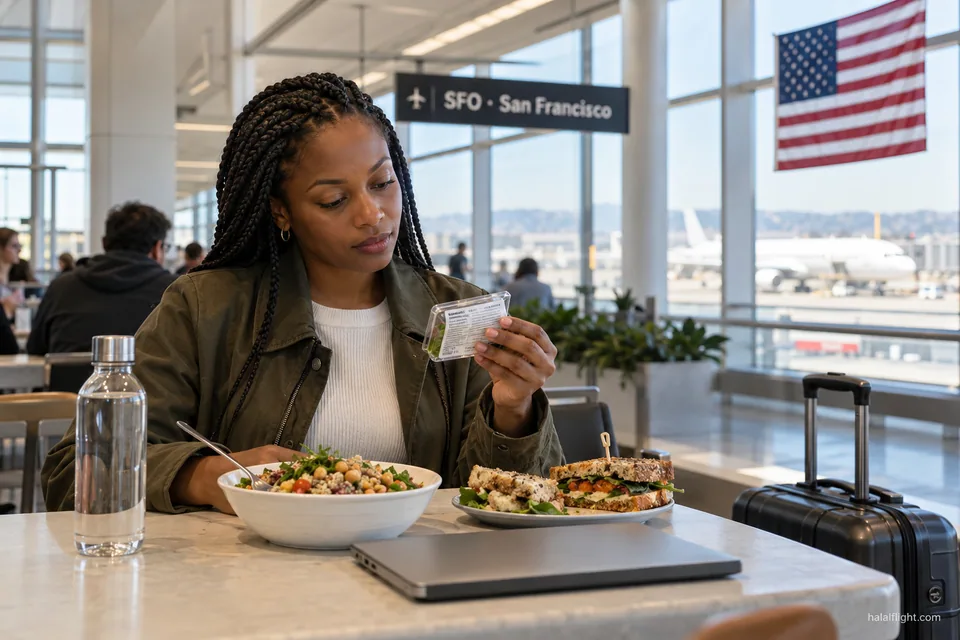
Grab-and-go sandwiches, wraps and bowls give you something that a counter conversation cannot: a printed ingredient list. Read the whole panel, not just the headline. Look for pork products, gelatine, lard, wine and other alcohol, and animal-derived flavourings. If a halal or similar certification claim appears on the pack, note the name of the certifying body and whether it is something you recognise and trust.
Claims that answer a different question
Words such as organic, natural, sustainable, plant-forward or local describe farming, sourcing or marketing. They do not describe whether meat was slaughtered according to halal requirements or whether a sauce contains alcohol. A familiar brand or a pleasant atmosphere does not either.
When the label is silent
- Ask staff whether the manufacturer provides more detail and whether anyone can check.
- Photograph the label so that you can research it later or ask someone you trust.
- If a question remains unresolved and the item is not essential, put it back and choose another.
It is better to leave a doubtful product on the shelf than to buy it and spend the flight uncertain.
Bowls, salads and mixed dishes
A vegetable-heavy bowl seems to be the safest thing on a menu, but several components are made in advance and combined before you see them. The grain base can be cooked in stock, the roasted vegetables can be finished with animal fat, the dressing can contain wine vinegar or another alcohol-based ingredient, and cheese can be added automatically unless you ask otherwise.
Questions that make a difference
- Which parts of this bowl are already mixed together, and what is in the mix?
- Is the grain cooked in water, vegetable stock or meat stock?
- Can the dressing and the cheese be left out, and is the substitution really possible at this counter?
- What oil or fat is used on the grill or in the pan?
Meat and fish additions
When you add a protein, ask where it comes from and whether the supplier gives halal documentation. A kitchen that is not able to state the source cannot offer an assurance, however friendly the answer. Fish and eggs raise fewer concerns about slaughter, but marinades, batters and shared fryers can still raise the other questions on this page.
Choosing fresh-looking ingredients does not tell you how the kitchen prepared the base, so ask rather than guess.
Using the late-night list
SFO publishes a separate guide to restaurants and shops that stay open late, together with vending options. This is useful for red-eye departures, late arrivals and flights that run behind schedule, when many ordinary outlets have closed.
How to use it well
- Compare your likely time at the airport with the hours shown in the list.
- Allow for delays: a flight that is one hour late may turn an open outlet into a closed one.
- Check the location, because late-night outlets are not necessarily near every gate.
- Keep a backup in case the listed place has shortened its hours.
About vending machines
Vending options are listed, but their presence does not mean that a suitable product will be in stock. Machines can be empty of the items you want, and the selection tends to be packaged snacks with ingredient lists. If you plan to rely on one, read the label on the item through the glass or after purchase, and do not assume a machine in one terminal stocks the same products as another.
For anything where you need certainty, the most dependable choice is to bring something sealed from home or buy it earlier in the day.
Prayer, fasting and timing at the airport
The sources consulted for this guide do not describe a prayer room at SFO, and the airport’s dining pages do not link food and prayer. If you want to pray at the airport, ask an information desk after you arrive, or contact the airport before you travel, to find out what quiet space exists on your side of security. A related page on this site covers preparing wudu for a flight, so this guide does not repeat that topic.
If you are fasting
When your journey falls on a fasting day, decide in advance where and when you will break the fast, based on sunset at your location. Buy and check the food earlier in the day, since the moment the fast ends is a difficult time to be searching for a clear answer from a counter. Dates, nuts and fruit are easy to verify, easy to carry and suitable for the first bite.
Remember that the airline may also offer special meals on board, which is a separate arrangement that has to be requested through the airline in advance. Airport food and in-flight food are two independent questions.
Final checks before the boarding walk, and what to do if it goes wrong
Buy your meal while you still have time to read the label or get an answer. Then watch the gate information for changes, because a late gate change can pull you away from where you intended to eat.
Checklist
- Note your terminal and gate area before you arrive.
- Shortlist two outlets with the directory filters and the map.
- Check the late-night list if you will be there in the evening.
- Read the full ingredient panel on any packaged product.
- Ask about stock, fats, dressings, cheese and the source of meat.
- Keep a small, sealed reserve for the flight.
If it goes wrong
- If an outlet is closed, go back to your second choice instead of searching at random.
- If you cannot verify anything, choose fruit, plain nuts or a sealed snack with a label you can read.
- If you find afterwards that a meal contained something you meant to avoid, stop and ask a qualified scholar how your situation is treated.
A small, verified reserve is more useful than a perfect plan, because it lets you decline a doubtful purchase without going hungry.
Frequently asked questions
Does San Francisco airport have halal food?
SFO's dining directory lists outlets by terminal and gate area but does not mark dishes as halal, and the sources checked for this guide name no certified outlet. Use the filters and map to find food in your area, then read labels and ask staff about meat source, stock, sauces and alcohol before you buy.
How do I find restaurants near my gate at SFO?
Note your terminal and gate area, apply that filter in the airport's dining directory, then open the interactive map to see where each outlet sits relative to your gate. International flights use the A and G gate areas. Check the opening status for your travel time and keep a second option in case of closure.
What can I eat at SFO late at night?
SFO publishes a separate list of restaurants and shops open late, along with vending locations. Compare the hours with your expected time at the airport and allow for delays. Vending machines may be out of stock, so carry a sealed snack with a readable ingredient list in case nothing suitable is open.
Is an organic or vegetarian sandwich automatically halal?
No. Organic describes how ingredients are grown, and vegetarian describes the absence of meat, but neither addresses alcohol in a dressing, gelatine, animal rennet or shared preparation surfaces. Read the full ingredient panel, ask about anything unclear, and refer religious questions about doubtful ingredients to a qualified scholar.
Should I bring my own food when flying from San Francisco?
Bringing sealed, non-perishable food such as nuts, dried fruit or bread gives you a dependable fallback when nothing at the airport can be verified. Check the current rules for liquids and food on the airline and security-agency websites before packing, and avoid carrying perishable food unless you can keep it cold.