The two models in one view
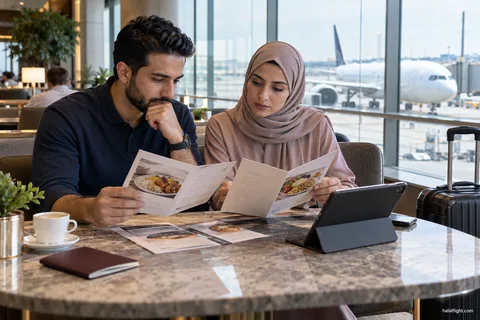
Broadly, travellers meet two approaches. In the first, the airline states that its meals are halal, so the ordinary meal is the halal meal. In the second, the airline serves a general menu and offers a Muslim meal as a special meal that must be requested in advance, often with rules about cabin, route or timing.
Gulf carriers are the usual examples of the first approach, and many European carriers of the second. That is a pattern, not a rule, and it has exceptions. Treat the region as a prompt for questions, never as proof of a policy.
The comparison below uses only what airlines say on their own pages. Where a page was not readable for this guide, the text says so and points you to the page to check.
What Gulf carriers publish
Halal as a stated baseline
Emirates states that its meals are halal certified. Etihad states that all meals it serves are halal and describes complimentary halal meals or snacks on every flight. Qatar Airways states on its special meals page that all meals are halal.
Where the differences appear
The extras are not identical. Etihad limits special meals on shorter flights to a short list and does not offer children's meals there. Emirates notes that some dietary meals are not available in Economy on flights under two hours. Qatar Airways asks for special meals, including children's meals, at least 24 hours before departure. In every case the halal baseline is automatic, while the additional dietary choices are narrower on short sectors.
What European carriers publish
European airlines are less uniform, which is why they need individual reading. Air France explains halal sourcing and the ingredients it excludes on its meal definitions page, and British Airways publishes its Muslim meal rules, including eligible cabins and deadlines that can differ by direction. These are the kind of detailed pages that make planning easier, but the specifics belong to those airlines' own pages, so read them for your route rather than relying on a summary.
Discover Airlines, part of the Lufthansa Group, is a good example of how conditions can narrow. Its special meals page says meals can be ordered free of charge up to 48 hours before departure, through My bookings on lufthansa.com, the Service Center or a travel agency. The free offer covers all classes on long-haul flights and only Business Class on short and medium-haul flights. The same page lists Muslim meals among the extra meals offered on flights to and from Canada, and does not describe them elsewhere.
A traveller reading that page learns something valuable: the Muslim meal may not be a universal option on that airline. That is exactly the sort of limit to find out before you pay.
Request timing: 24 hours or 48 hours
Deadlines differ more than most travellers expect. Qatar Airways asks for special meals at least 24 hours before departure. Etihad and Emirates also use a 24-hour pattern for extra meals. Discover Airlines gives 48 hours.
If you fly a European carrier on the way out and a Gulf carrier back, you may face two systems with two clocks. A practical rule is to request every meal at the time of booking, and to confirm again about three days before travel. Look for the request on your booking, not only in an email.
Remember that a Muslim meal on a European carrier is a request, so a late booking can mean you receive the standard meal.
Departure kitchens and hubs
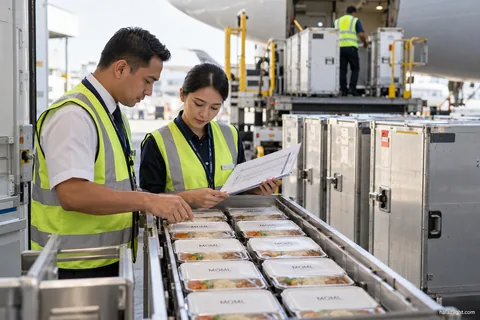
The airline's home region does not always decide where the food is cooked. A flight leaving a foreign airport may be catered locally, and the policy that applies at the hub may rest on a different arrangement there.
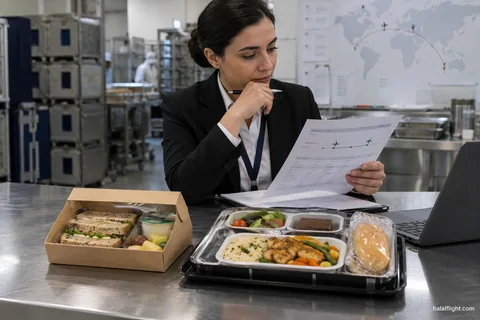
This matters most on return flights from outside the airline's home country. If your standard is a named certification, ask in writing how the airline's halal policy applies at that departure airport. For a general airline statement, the published page may be enough. Be clear with yourself which standard you hold before you compare.
Partner flights and codeshares
On a mixed itinerary, the aircraft may belong to a partner. Qatar Airways states that it cannot guarantee special meals on codeshare partner flights and advises travellers to confirm with the operating airline. The same logic applies to every airline in this comparison.
Find the operating carrier on your confirmation, then read that carrier's policy. A Gulf airline's halal statement does not carry onto a European partner's aircraft, and a European airline's special meal arrangement does not necessarily apply on a Gulf partner's flight. Write to the operating airline if its page is unclear.
Convenience against assurance
The strongest assurance is not always the most practical choice. A direct flight on a carrier with clear special meal rules may serve you better than a longer journey on a carrier whose regional reputation feels reassuring but whose pages say little.
- Count total journey time, including connections, because long waits raise your reliance on airport food.
- Count the number of airlines involved, because each is a separate policy to check.
- Count the effort of confirming meals, which grows with every request-based leg.
A fair comparison weighs these alongside the wording of the halal policy.
Checklist and what to do if it goes wrong
- Read each airline's own meal page and save the date and the exact wording.
- Decide whether you need a named certificate or an airline statement.
- Request any Muslim or special meal at booking, and check the booking for confirmation.
- Identify the operating airline on every segment.
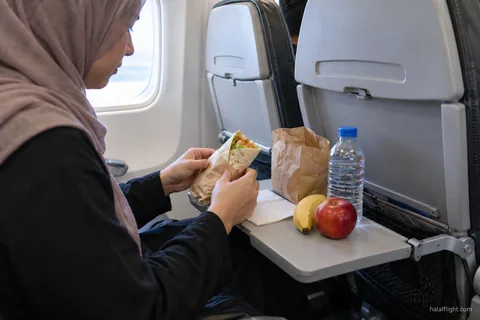
- Pack a sealed snack for short flights and for missed meals.
If your requested meal does not arrive, tell the crew politely and ask what is available. After the flight, complain in writing with your booking reference and the policy text you relied on. For personal religious questions about what is acceptable, consult a qualified scholar.
Frequently asked questions
Are Gulf airlines always halal?
Emirates, Etihad and Qatar Airways each state on their own pages that their meals are halal, but that applies to flights they operate. A partner-operated flight follows the partner's catering. Check the operating airline on your booking and read its page before assuming the same policy applies.
Do European airlines serve halal meals?
Many do, usually as a Muslim or halal special meal requested in advance. Air France and British Airways publish their own rules, and Discover Airlines states its special meal timing and lists Muslim meals for flights to and from Canada. Read the specific airline's page for your route and cabin.
How far in advance must I request a halal meal on a European airline?
It varies. Discover Airlines says special meals can be ordered up to 48 hours before departure, while other airlines publish their own timings, sometimes by direction. Requesting at the time of booking is safest, and you should check the airline's current page before travelling.
Is a Gulf airline better than a European airline for halal food?
Not automatically. A Gulf airline may make planning simpler by stating halal as the default, but a longer route or a connection with no meal can cancel that advantage. Compare the whole journey, including who operates each flight and whether food is served on each sector.
Will the return flight have the same halal arrangement?
Not necessarily. Catering can differ by departure airport, and some airlines describe their policies differently depending on where the flight starts. Check the return departure and, if you need a certificate, ask the airline in writing how its policy applies there.
What should I do if I am given a non-halal meal?
Tell the crew calmly, ask what alternatives are available and what each contains, and avoid eating anything you are unsure about. Keep the flight details and write to the airline afterwards. A sealed snack in your hand luggage gives you a fallback.