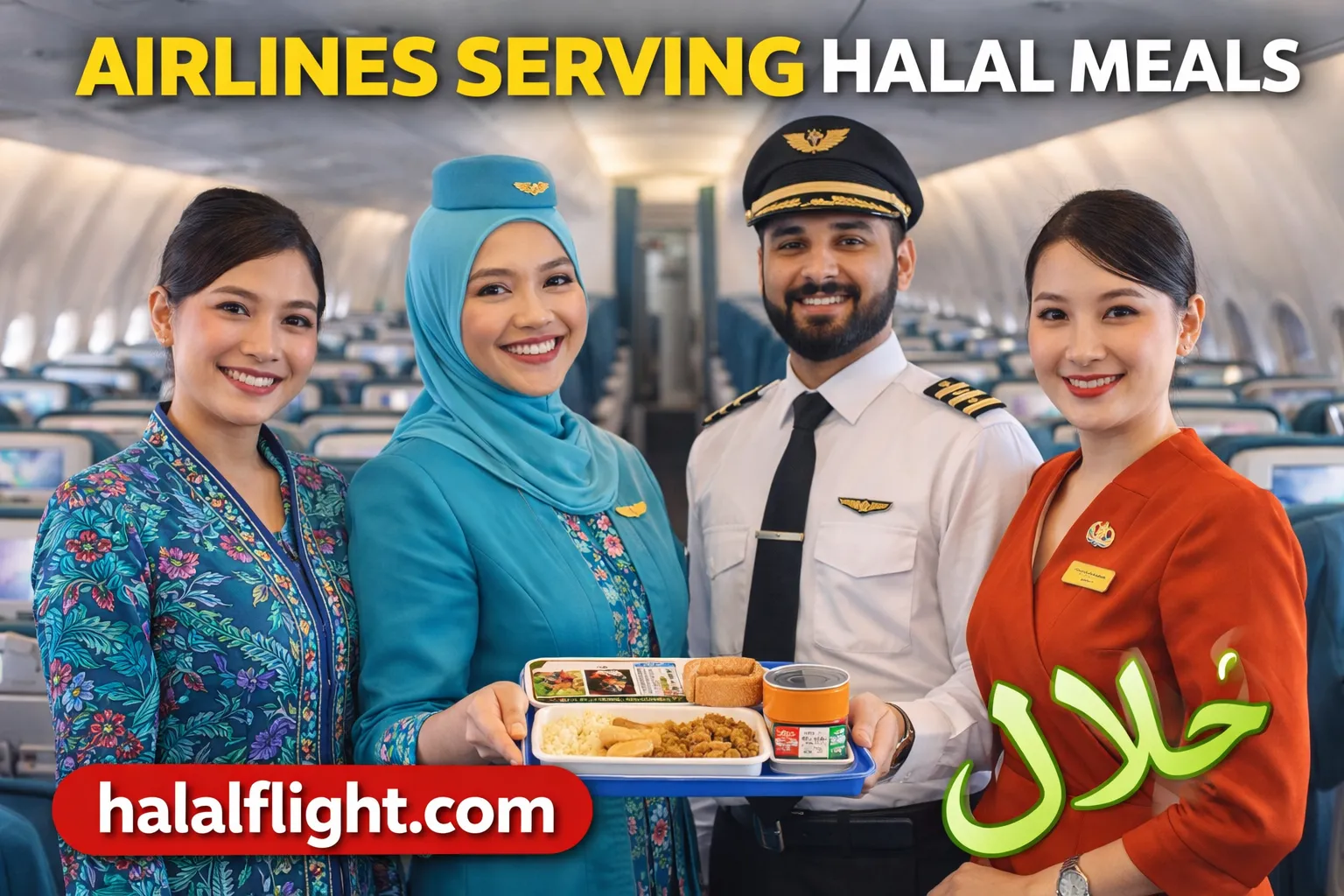
AIRLINES SERVING HALAL FOOD
Airlines serving halal meals are air carriers that integrate Sharia-compliant food into their in-flight catering processes, either through fully certified halal supply chains or through standardized “Muslim Meal” options designed to exclude prohibited ingredients such as pork and alcohol while maintaining operational feasibility across international routes.
Objective of providing halal meals on commercial airline flights
The objective is to ensure that Muslim passengers can consume food that aligns with their religious obligations during air travel, while allowing airlines to serve diverse passenger profiles without disrupting large-scale catering logistics that must remain efficient and standardized across multiple destinations.
Functioning of halal meal preparation and distribution in airline operations
Halal meals are prepared by contracted catering companies at departure airports, following predefined specifications, then sealed, labeled and loaded onto aircraft, where cabin crew distribute them to passengers who have requested them in advance through booking systems or customer service channels.
Types of Sharia-compliant meals served by airlines depending on their positioning
Airlines typically offer either fully halal-certified meals, especially in carriers based in Muslim-majority countries, or “Muslim Meals” that exclude pork and alcohol but may not be certified across the entire preparation chain, depending on the airline’s sourcing and catering structure.
Differences between fully halal-certified meals and standard “Muslim Meal” airline options
Fully halal-certified meals involve strict compliance including certified slaughter, ingredient traceability and controlled preparation environments, whereas “Muslim Meals” follow simplified rules, focusing on ingredient exclusion without guaranteeing full certification of the entire production process.
How to request a halal meal on international airline flights step by step
Passengers must request halal meals during ticket booking or through the airline’s “manage booking” interface, usually at least 24 to 48 hours before departure, as these meals are prepared in limited quantities and not stocked as standard onboard options.
Criteria used by airlines and caterers to define halal compliance in flight meals
The criteria include the absence of pork and alcohol, the use of halal-certified meat where applicable, strict ingredient control, separation of food preparation areas and compliance with both food safety regulations and religious guidelines depending on the airline’s policy.
Operational limitations affecting halal meal availability across routes and aircraft
Availability depends on flight duration, departure airport catering capabilities and passenger demand, with long-haul routes offering more consistent halal options, while short-haul flights may not provide special meals due to logistical constraints.
What qualifies as halal food in aviation and what does not meet Sharia standards
Meals containing pork derivatives, alcohol, non-certified meat or prepared in environments with cross-contamination risks are not considered halal, even if labeled as special meals, highlighting the importance of verifying the level of compliance offered by each airline.
Market reality: variability of halal meal standards across airlines and regions
In practice, the level of halal compliance varies significantly between airlines, with some offering fully certified systems and others providing simplified options, making it essential for passengers to check details in advance to ensure alignment with their expectations and religious requirements.
- Halal flights the guide for airlines with in-flight sharia compliant food
- Airlines serving halal meals
- Air Algerie Halal Meal
- Air Asia Halal Meal
- Air China Halal Meal
- Air France Halal Meal
- Air India Halal Meal
- Air Senegal Halal Meal
- Biman Halal Meal
- China Southern Halal Meal
- Egypt Air Halal Meal
- Emirates Halal Meal
- Etihad Airways Halal Meal
- Garuda Indonesia Halal Meal
- Gulf Air Halal Meal
- Indigo Halal Meal
- Iran Air Halal Meal
- Japan Airlines Halal Meal
- Kuwait Airways Halal Meal
- Libyan Airlines Halal Meal
- Lufthansa Halal Meal
- Malaysia Airlines Halal Meal
- Pakistan Airlines Halal Meal
- Qatar Airways Halal Meal
- Royal Air Maroc Halal Meal
- Saudi Airlines Halal Meal
- Singapore Airlines Halal Meal
- Syrian Air Halal Meal
- Thai Airways Halal Meal
- Turkish Airlines Halal Meal
- UK Halal Hotel
- Umrah Price Comparator
- USA Halal Hotel
- Halal Swimming Pool
- Halal flights the guide for airlines with in-flight sharia compliant food